Europe doesn't just have an energy crisis though, if Russia decides to cut off the gas they straight up have insufficient energy to make it through the winter. The decline in the Euro is pricing in the risk of catastrophic shutdowns of industry across Europe.
All of it a result of moronic politics around nuclear and a failure to build out fossil fuel capacity while the green energy transition was still in progress.
If you started building a nuclear plant ten years ago, it will be finished when the crisis is way over.
Nuclear certainly is crucial in the mix. And used as such: Europe has a lot of nuclear power.
But nuclear is slow. Terribly so. Even an operational plant needs days to react to increasing or decreasing demands. And building such plants from scratch, or extending existing ones, takes decades. Never months.
I've been hearing the same line about nuclear plants taking decades to be built for decades, as if its a valid dismissal. As the saying goes, the best time to plant a tree was a decade ago, the second best time is now. We should be scaling up our nuclear capacity.
Any effort spent building nuclear for the 2040s is effort that could build 5x as much solar and wind for 2025.
Plus transitioning to nuclear just builds another set of kochs and saudis.
Plus it makes your entire economy beholden to one of China, Russia, France, or the US.
Plus it just kicks the can down the road. If you consider direct thermal forcing. We are exactly where we were in the late 19th century with greenhouse gases. There is no option but to transition to a steady state economy, and starting a bunch of projects that only pay off if you use as much energy as possible from them (and even then, solar + storage will be a fraction of the cost by the time they open) isn't the way to get there.
Plus those same five countries won't even let half the world have nuclear power plants.
Plus the world's uranium reserves won't actually last very long if you carry on with exponential growth (doubly so without reprocessing and breeding).
Then there's all the usual risks people mention.
The solution is the same as it has ever been. Degrowth, stopping waste, and renewables.
If Europe can continue to buy cheap Russian gas and oil and use it as they have done in the past then 5x as much solar and wind for 2025 sounds great. That was the Great Plan of the green movement in Germany. In 2010, 2020, 2030, 2040, 2050 or a time after that green hydrogen will become cheaper than Russian gas and oil and then this plan will be completed.
If however Europe can't continue to burn gas and oil when demand exceeds supply because of the weather, then there is a major problem that is going to need fixing in a very expensive and time consuming way. If green hydrogen don't drop in price and no other storage solution can arrive to become cheap than gas and oil, then the climate change goals won't be achieved.
To add to the problem in northern Europe, the locations for hydropower is practically already at maxed utilization. They are also quite old and with large maintenance debts. They are also is causing extinction of several species, and fixing that would cost prohibitively much money, and the solutions will reduce outputs.
The thing is, 5x solar and wind sounds great but if I can specific the time and space for it, I would make a great profit of trading 5 units of energy for 1x at a different space and time. The price difference in northern Europe can be a factor of 10 or even higher between low and high. 5 kwh worth 3 cent each is worth much less than 1 kwh worth 40 cent.
Solar and wind are nice, but they don't solve the base load problem. They aren't consistent enough to operate as base load on a power grid. They are certainly convenient for maintaining peak load, but without solving the energy storage issue in parallel to the added capacity, we need alternatives.
Then comes storage, curtailment, and backup (always necessary: fossil-fuel plants always produce around 9% of electricity in fully-nuclearized France).
Moreover backup is now provided thanks to gas turbines, and we know to run them thanks to hydrogen (clean), which can be green hydrogen (cleanly produced thanks to renewable sources overproduction).
There is no need for each location to deploy each and every type of production unit: each region has its own geography and preferences.
Those benefiting from huge potential for hydro, offshore wind or solar (deserts...) are at an advantage.
Those benefiting from a low production time-profile correlation with most other ones also are blessed.
Those totally unable to deploy anything probably don't need huge amounts of energy or are rich to the point of already importing it (is there a counter-example?).
I have read several of those studies with an automated workflow to find suitable pumped hydro/wind/solar and they consistently miss local awareness. They often use deeply inaccurate land cover classification when the simple usage of open street map could have helped, and for hydro they underestimate the recent local opposition to destroy a village to build a dam.
There's a lot of low hanging fruit in the hydro landscape that people miss.
I have a rivulet that runs near my house. It has weir dams at a few locations on it's path down our mountain, IT wouldn't be that hard to extract energy from the constant flowing water there to feed into the grid. There are turbines that exist to extract energy from a meter high head of water.
Everyone thinks about power like you need one big dam, or one big plant (coal or otherwise). There's a lot of small fast flowing streams that have potential to create extra energy.
I think hydro needs to be reimagined. IT always need to flood valleys to be in the mix.
That really depends on what percentage of water's potential energy is expended in small creeks and the like vs big rivers.
I actually have no idea how to estimate that. Anyone have a good estimate on that? Intuitively, I'm thinking that most of those rivers are fed by many small streams, so it would be approximately equal. I'm entirely unsure of that though so treat it as having huge error bars.
The problem becomes one of how spread out the energy is.
Sure the water in that creek might be falling hundreds of meters, or even kilometers, but without a dam the height differential at your generator is only going to he a few metres at best. Enough to power the lighting, fridge, and washing machine in the houses that the creeks happen to run by, but not much else.
With the advent of long lasting perovskites and (hopefully) some less polluting battery technologies you're not even better off cost-wise.
You might be able to do something with a long pipe parallel to the creek to get more head, but then you're going to spend a lot of your energy on wall friction unless it's very wide.
> Sure the water in that creek might be falling hundreds of meters, or even kilometers, but without a dam the height differential at your generator is only going to he a few metres at best. Enough to power the lighting, fridge, and washing machine in the houses that the creeks happen to run by, but not much else.
Could be, but that's a bunch of stuff you don't have to power with the existing system. Given how many creeks there are, that seems like it could really add up.
> With the advent of long lasting perovskites and (hopefully) some less polluting battery technologies you're not even better off cost-wise.
That's fair. I've learned in my life that I don't have a good intuition for what the costs of large infrastructure projects are.
Who is going to run all the little dams and turbines, though? And how would it ever be cost effective to do so? There is so much maintenance on small lakes that don’t even have a turbine (mainly dealing with silt, which accumulates steadily and is hugely expensive to remove).
Yeah in this example, the water is never stopped. Not even the flow rate, It's just held back for a moment to create a convenient potential energy situation.
This https://www.youtube.com/watch?v=Bhyi1DjGti8 Is something that could be built near a bus stop near my house and not negatively impact anyone outside of the initial construction.
A few example large solar plants in the US seems to have ~500MW capacity, ~30% capacity factor (so ~200MW effective capacity), and taken 2-5 years to build [1][2][3].
A nuclear plant will probably have multiple 1GW reactors, with very high capacity factors. I think your numbers are very optimistic.
Pumped storage is hard because you need a lot of space on a hill for a reservoir. Perhaps we can turn lake mead into a giant pumped storage project with a bunch of solar installed over it to limit evaporation. Then use wind, solar, or even nuclear to fill it (but that’s a lot of water that farmers might want for their fields, again, limiting evaporation is important).
Building a nuclear power plant today is assuming storage for solar and wind will not be figured out within 50 years, allowing you to sell electricity at todays price for at least this time. You can see why no one wants to take that bet. It's over, it was already over 10 years ago, stop trying to fit every crisis around a "nuclear was unfairly maligned" obsession.
The Germans are shutting down perfectly serviceable and world-leading (in terms of safety) nuclear reactors purely out of doctrinaire ideology of the Green Party.
Probably not from Germany, are you? The greens were not part of this decision when it was actually made.
Yes, there was some anti-nuclear sentiment after Fukushima which made for an opportunity. But it was long in the running. Both the SPD and CSU/CDU had interests here. Lots have been written on this in established media, should you wish to delve deeper.
Yes, but the original plan of the Greens seeked to use nuclear power as a transitional technology to first replace coal. While the build up of renewable energy in Germany during the last 2 decades is very impressive, adding more gas to the mix certainly looks idiotic in hindsight. This wasn't the Greens fault, as they haven't been in government since 2005. They are now the ones having to deal with it though.
Yes they were. The decision was made under Schröder/Fischer around 2006.
It was reverted as soon as the CDU took over, and reverted back after Fukushima. But it is originally a "Green" idea and ideology, and it remains to be one today (see: Bavaria trying to get their plants recertified after 2022, because of the gas situation, and Berlin - staunchly Green - fighting it.)
Or just a strong desire that surely somehow this was the green's fault. It's not inconceivable as they have an anti nuclear slant, but this one isn't remotely on them. They do have to deal with the fallout however.
In my book, a party that set up the Atomausstieg, after campaigning on the topic for a decade, after grossly overstating the potential dangers of nuclear, while supporting grassroots anti-nuclear groups and engaging in borderline criminal protests that often endangered nuclear transports doesn't get to play coy once the shit hits the fan in my book.
I think we agree on almost all points, maybe with the exception on the overstated dangers argument. (One should always focus on the good arguments and not the bad, and there are plenty of educated people making coherent arguments without resorting to fear mongering.)
Anyway, don't let this cloud your judgement. There are economic issues here, and economics concerns trumps environmental, in Germany and elsewhere. This would have happened even if no anti nuclear campaigning had ever taken place.
In fact, it might even have happened faster if there wasn't also a big push for renewables, which have taken a lot of resources. The people really responsible should answer for this and not some convenient scapegoats.
The nuclear reactors would have been due for a thorough 10-year check-up in 2019 which was omitted because of the approaching shutdown. So claiming this was "purely out of doctrinaire ideology" seems unreasonable.
True. And it was immediately reversed when Merkel's conservative government took over. And then again reversed by the same conservative led government after Fukushima.
I think money, perk and power go a longer way than ideology. There were probably backroom stuffs we didn't know about. It takes a LOT of cash to feul any movement that huge.
The German parties advocating a Nuclear exit did so because the Germans wanted them to do so. Nuclear power really wasn't (probably still isn't) popular in Germany.
Don't you say. Is there also a wikipedia article on how to replace all industrial, commercial and domestic heating infrastructure with those? Europe wide?
Electric radiators are quite cheap (they retail for less than $100), and homes in the cold parts of europe are typically well insulated, and if you bought a radiator for every person in the eu (0.5B * $100) it would cost .3% of europe's gdp ($18 trillion), or 5% of the eu's budget for 1 year. This helps reduce the reliance on gas for domestic heating.
Those heaters heat one room, not a house or appartment complex. They consume a ton of electricity, are higly inefficient and don't heat your water supply. And while they maybe cheap (are those cheap ones rated for contonous usage or are they some cheap Wish knockoffs?) they are not available in sufficient numbers... Seriously, how comes that people fail to realize how complex things around them are, like infrastructure? These things are not like a consumer grade app or some ride share business...
Not sure where you're getting your facts. I'm sitting in a house with all of these things you claim don't exist, and I'm not an anomaly where I live. My water heater, cooking stove, furnace.. all electric. Most of it installed in the 80's and all original (other than the water heater which has a 10-15 year lifespan).
Electric water heaters and baseboard heaters are common, and extremely efficient. In fact, resistive heaters in the scientific sense (watts in vs. watts out) are the most efficient form of heating.
They're extremely reliable and cheap because of how simple they are.
They may not be _cost effective to run_ in many regions due to high cost of electricity (per watt as compared to gas). But here in BC Canada, resistive elements are extremely common due to relatively cheap power (Hydro in our case). For whole home heating, heat pumps are usually used in new builds because of their advantages, but they're still very tied to the grid and have elements in them for defrosting and the like.
If you scaled up nuclear you'd similarly see prices of electricity drop, and if you have the grid infrastructure (or build it), electric heating (for your home, water, cooking, whatever) becomes pretty attractive.
Sure it exists. My point was that switching from one to the other is the problem. Europe has issues with gett;ng gas and can't switch to electric. If you use electric and run into electricity issues you cannot switch to gas. Even if both solutions are working just fine.
Your comment I replied to claimed electric heaters were inefficient and not available in numbers. I also don't see any mention of existing infrastructure.
Most of the houses I've seen in Canada are heated using baseboard heaters, they're not exactly uncommon. Efficiency seems fine, and most of Europe doesn't get as cold as Canada during winter.
I'm standing on floor heating at this very moment (off, of course). It uses district heating / hot water, which could be heated by any kind of energy source, including nuclear.
The consumer side is actually a lot more trivial than you are making out. It's also about as efficient as gas (0% at the point of consumption as you are producing heat, with about 40% energy loss on the production side).
Electric heating is about the simplest machine you can possibly make (it's just NiCr wire and a thermostat which is already there), and the cost would almost exclusively be the labour of installation. Even heat pumps (including for water) could be built in relatively short order.
The problem is it would entail quadrupling the electricity generating and transmission infrastructure. This is the hard part that takes decades.
> Those heaters heat one room, not a house or appartment complex.
It’s something I’ve always wondered:
At night, it might be more cost effective to heat a bedroom electrically than an entire household with gas. But that’s a forced air heating issue: you can’t block 75% of a furnace’s airflow and expect it to keep working. Europe usually has boilers and radiators so dialing down heating to just a room is possible.
Or better yet, heat the person with a mattress pad instead of the building air at night.
Electricity heating does produce a bunch of heat at other places though, and it all comes from work, whereas the gas could only produce maybe 70% as much work if used some other way.
How is this 0% measured? I would think 1 J coming in from the wall making 1 J of heat means 100% efficient.
Yes there are inefficiencies at generation and transportation. But I don't think those are usually counted when talking about the efficiency of a home device. And it certainly won't be enough to bring it down to 0%.
As an illustrative example, you could get the same heating effect by putting the electricity through a computer or other appliance, or by putting the gas through a heat engine to produce electricity which is used inside the home and warming the house with the waste heat.
Hmm, that type of measurement probably works in some situations, but I don't think it works for heating. For example, I don't think that type of measurement would be as useful for comparing resistive heaters to heat pumps.
I know about heating by computer because for the last several years I've heated my apartment solely by mining Ethereum on my computer. The only dedicated heaters that my apartment has are resistive electric heaters built into the walls, so it's better for me to get a little Ethereum plus heat than just heat.
I don't like the framing of thermalizing potential energy being 100% efficient because efficiency as a general concept is the fraction of what you did vs. what you could do. It's incoherent mathematically, poor communication, and inconsistent with the way the word efficiency is used in other contexts in everyday speech. Direct thermalization is the least efficient possible action. It also leads to absurd statements like 'heat pumps are 400% efficient'. This is further exacerbated by the communication not expressing the upper bound in any coherent way (which is about 800-900% by this framing depending on temperature differential).
You could frame it as fraction of the heating that is possible at carnot efficiency, I guess. Ie. the amount of heat you put into your room / the amount of heat you with a perfect machine could at typical temperature differentials.
Then an element would be about 10-15% efficient (as measured at the wall vs. an ideal heat pump) and gas would be...awkward to calculate (I'd have to open up a textbook if not just multiplying max COP and max thermal efficiency of a heat engine), but somewhere in the 20-30% efficient range. Electric including a thermal generator would be in the 8-10% range somewhere.
Electric heat pumps would be around 50-70% by this metric, or in the 25-40% range somewhere if using a thermal generator.
Thinking about it, I like this metric because it really highlights how much more wasteful burning gas to heat a home with electricity is if you're not using the waste heat for something. If you're not using renewable electricity, even heat pumps don't break even if they're not high quality and well maintained.
Really drives home the importance of insulation and good curtains in cold areas.
Edit: looking at absorption heat pumps, they seem to be a little better than my guesstimate. I think they outperform fossil fuel powered electric heat pumps.
Yes, 100% efficient. But a heat pump is over 100% efficient because it pumps in additional heat from outside instead of just using the electricity's heat.
In fact, electric heating was actively discouraged and built back around 1995. It was often being replaced with gas and wood pellets (which also come from Ukraine/Russia).
This is bullsht and i made an account just to tell you why:
- Large parts of the Uranium are coming from Russia
- Nuclear power is not competitive and nuclear power is very expensive (especially if you conside the costs the government will be left holding the bag on, becuase nuclear power plant companies will spin off their power plants to new companies to go bankrupt once the profiting is done and the cleaning up the nuclear remains starts), no matter how much the pro-nuclear people want to lie about it
- Nuclear power is statistically not dangerous compared to fossil fuels, but not compared to renewables.
- The world's uranium supply is running out. Already since the late 1980s, uranium mines have been unable to meet the world's annual demand. The nuclear industry has so far filled the fuel gap with material from military and civilian stockpiles.
- Nuclear waste is a problem no country except Finnland is anywhere near solving. Germany has been trying to find a permanent nuclear waste storage location since 1999 and have not come closer to finding one since then, because every time the current favorites are revealed the "not in my backyard" screeching starts and local politicials force a restart of the search.
- Many of the world's nuclear power plants are old, because hardly any new ones have been built in ages, because ...
- The construction of nuclear power plants is unbelievably expensive and takes decades, and much of the know-how on how to build nuclear power plants has been lost in europe over the past decades because so few are being built, which drives up the costs even further.
- We still have 7 years of CO2 budget in Germany, so why do some politicians talk about building new ones, although they would only be finished in 20 years at the earliest (and we in DE can't even get the berlin airport built in anything close to the deadline, how long does a nuclear power plant take then ?)
- Budgets for nuclear power plants take budget away from renewables
- We have to change from a centralised to a decentralised grid, nuclear power is a step in the wrong direction
- Nuclear power plants make us dependent on dictators
- Climate change has an impact on reactor operations. With global warming, extreme weather events are on the rise. Unlike renewables, however, nuclear power plants are not adaptable. Rather, their danger increases in our changing climatic conditions.
- Our neighbour france has heavily invested in nuclear power and is is a complete shtshow. There are constant headline to the extend of "Low temperatures caused another french nuclear power plant to go off the grid, worsening the skyrocketing energy prices in france" (The same with "too high temperatures" any many other reasons). Even before the war they had an energy shortage.
The 3 remaining nuclear power plants in germany are:
- Emsland (1335 MW)
- Isar/Ohu 2 (1410 MW)
- Neckarwestheim 2 (1310 MW)
All three are pressurised water reactors and thus not as bad as boiling water reactors, but total rubbish compared to liquid salt reactors.
Moreover, all three have been in operation for over 30 years and all three are due for a "periodic safety review" (every 10 years), which was allowed to be ignored during their last 3 years of operation due to a "grace period under the Atomic Energy Act".
If they were allowed to continue running, the operation time extension of the of all three would start with at least one month downtime, because these inspections would have to be started again. These inspections would most likely also reveal necessary repairs, wich would further delay the timeframe.
By the way, all three power plants have not been employing new staff for some time because they knew the would soon be shut down soon anyway.
In short: these nuclear power plants have been preparing for their shutdown since 2011 and have let everything slide over the last few years because everything will soon be demolished anyway. There are not the necessary fuel rods, not the necessary personnel, not the necessary will of the operating companies and no safety checks that would be necessary for continued operation.
Also: Merkel decided in 2011 (one day after the nuclear power plant disaster in Fukushima) to not allow nuclear power after the 31.12.2022. Merkel, famously in the green party . (for anybody with no clue about german politics: Merkel is in the conservative party)
The conservative opposition needs things to disagree on with the government, the current government had no scandals so far and the conservatives are still salty for being voted out of government, so they just make sh*t up and currently that is the myth of our magical saviour nuclear power.
A nuclear reactor can be built in three years, though admittedly this hasn't happened in Europe. They are mostly (85%) built in under ten years. Figure 3 shows we should expect around 5 years. https://euanmearns.com/how-long-does-it-take-to-build-a-nucl...
>- Large parts of the Uranium are coming from Russia
Not immutable. There are other sources that are much friendlier
>- Nuclear power is not competitive and nuclear power is very expensive (especially if you conside the costs the government will be left holding the bag on, becuase nuclear power plant companies will spin off their power plants to new companies to go bankrupt once the profiting is done and the cleaning up the nuclear remains starts), no matter how much the pro-nuclear people want to lie about it
I doubt this hyperbolic assertion. Prove it.
>- Nuclear power is statistically not dangerous compared to fossil fuels, but not compared to renewables.
Again, prove it. This is unsupported, and in fact from what I've seen, false. So provide some evidence.
>- The world's uranium supply is running out. Already since the late 1980s, uranium mines have been unable to meet the world's annual demand. The nuclear industry has so far filled the fuel gap with material from military and civilian stockpiles.
This is again, an unsourced claim. In fact, a quick google shows: "There is not now, nor has there even been a shortage of uranium. Fear about reliability of the supply of uranium has been used in the past as an excuse to get something else done." Source: https://www.forbes.com/sites/llewellynking/2020/06/08/uraniu...
>- Nuclear waste is a problem no country except Finnland is anywhere near solving. Germany has been trying to find a permanent nuclear waste storage location since 1999 and have not come closer to finding one since then, because every time the current favorites are revealed the "not in my backyard" screeching starts and local politicials force a restart of the search.
I agree this is a problem, but it isn't one that is unsolvable. It's a cultural issue, not a physical one.
>- Many of the world's nuclear power plants are old, because hardly any new ones have been built in ages, because ...
>- The construction of nuclear power plants is unbelievably expensive and takes decades, and much of the know-how on how to build nuclear power plants has been lost in europe over the past decades because so few are being built, which drives up the costs even further.
This isn't inherent, it can change, especially with political need.
>- We still have 7 years of CO2 budget in Germany, so why do some politicians talk about building new ones, although they would only be finished in 20 years at the earliest (and we in DE can't even get the berlin airport built in anything close to the deadline, how long does a nuclear power plant take then ?)
CO2 budgets are now irrelevant currently. China and Russia do not give a shit about CO2 emissions; their energy and GDP are heavily dependent on them. Globalization was the only mechanism that allowed the world to enforce these two countries to behave with emissions, and with the ongoing breakdown of the globalized system, there's no reason they'll reduce emissions. Why cripple Germany's economy to meet a target that the world's largest emitters aren't willing to get anywhere close to?
>- Budgets for nuclear power plants take budget away from renewables
Possible, but renewables have their own downsides, which are well articulated everywhere.
>- We have to change from a centralised to a decentralised grid, nuclear power is a step in the wrong direction
Why?
>- Nuclear power plants make us dependent on dictators
>- Climate change has an impact on reactor operations. With global warming, extreme weather events are on the rise. Unlike renewables, however, nuclear power plants are not adaptable. Rather, their danger increases in our changing climatic conditions.
This makes sense, but I'd suggest that it's probably possible to take this into reactor design.
>- Our neighbour france has heavily invested in nuclear power and is is a complete shtshow.
Source on this, I don't know much about it. I've heard only good things about France's nuclear program.
I agree this is a problem too, and this is why people point out there is also a physical issue which transcends culture.
In terms of radioactive properties remaining over a period of millennia during which a culture can be expected to have lost its identity, or been forgotten completely.
If the problem is not truly unsolvable, a permanent solution may still not be possible without close co-operation with a future sympathetic culture.
In Western Europe (in a political meaning) only Finland has tried for several decades. It's now 12 years behind schedule and the official message is that it will be running in winter (colder in Finland than in many othe places) when the lack of Russian energy will become most visible. Direct import of electricity and gas from Russia have been already stopped. At the moment that's not a problem because it's summer and you can import from other European countries. I'd be very suprised if you can do that in winter. If the nuclear power plant is not ready people will sit in the cold in 6 months from now. Or they will compromise on safety and just run the plant anyway. It is already loaded. No idea what will happen, but I should stop discussing on HN and order firewood.
As others already pointed out, the nuclear exit strategy was decided upon under Merkel's conservative government.
Some added information so: The Green party pushed for an exit of nuclear power as part of a social-docrat government. This exit eas actually pretty well worked out and planned. When Merkel took, one of the forst things was to throw that rather good plan out. Only to revert that decision, hastly at that, after Fukushima. That second nuclear exit, the one Germany is currrently going through, was hastly done, ill planned and rushed.
And lastly, nuclear power does exactly nothing to compensate for reduced gas deliveries. Germany, as in deed a good portion of Europe, is heating with gas. And not nuclear power or electrical.
It's only slow because of ridiculous and unnescessary regulations around it. They can easily speed things up while still keeping it safe, but their (and our/US's) laws are kicking themselves in the butt.
I think more so the precedent it set. Not switching on ~and~ not growing nuclear. It wouldn't be too ridiculous for Germany to be producing 30GW from nuclear by now. That's a 22GW spread from what it is today which isn't negligible.
But yeah, people are definitely being a little over dramatic on the severity.
Can’t heat with nuclear. Not in a way that’s relevant for this, anyway.
Heat is the main challenge and heating alone is problematic all by itself.
Gas dependence was a huge mistake, nuclear is not the short term solution we are looking for and getting away from gas dependence in the past couldn’t have relied on nuclear.
> Can’t heat with nuclear. Not in a way that’s relevant for this, anyway.
That is not a law of Physics. Electric heating is perfectly fine. It’s true that we cannot do it quick enough to matter in this case, but that is not a good reason to just shrug and not learn anything from this. We will need a long-term strategy, because even if we manage to come up with a temporary solution, it’s clear that these things will happen again in the future. It’s just too good as a way of applying pressure on European countries. Long term, it will have to be electric if we want to improve our energy supply and have a remote chance of not staying too far from our climate goals.
We should have seen this coming for quite a while. It was in fact predicted, but mostly ignored by politicians who seemed to thing that oil crises from the 1970s were fun and that energy independence was irrelevant.
This is an important point that quickly gets lost in a simplified debate.
Different types of power have different characteristics. Nuclear power plants runs at constant load and changes in power are slow. They take on the order of days to start and stop, and can not on their own follow load changes on a country wide network.
This isn't good or bad, it just is. They can manage the same base load day every day until they need servicing. But that also means you need other power sources to take the top load. That's usually natural gas turbines, even if it could be other things. Hydro is optimal, but most countries have a limited capacity for that. Which is, somewhat ironically, a similar situation as wind and solar have, but for completely different reasons.
Keep that in mind when people talk about replacing natural gas with nuclear. They do different things.
This mostly isn't physics, but rather a reflection of nuclear power's high capital costs. Nuclear plants have demonstrated that they can ramp up and down pretty quickly compared to e.g. most combined cycle natural gas plants.
"For example, according to
the current version of the European Utilities Requirements (EUR) the NPP must at least be capable of daily
load cycling operation between 50% and 100 % of its rated power Pr
, with a rate of change of electric
output of 3-5% of Pr per minute. " - it goes on to discuss how most modern light water plants significantly outperform this requirement.
"Most of the modern designs implement even higher manoeuvrability capabilities, with the possibility
of planned and unplanned load-following in a wide power range and with ramps of 5% Pr per minute.
Some designs are capable of extremely fast power modulations in the frequency regulation mode with
ramps of several percent of the rated power per second, but in a narrow band around the rated power level. "
> Keep that in mind when people talk about replacing natural gas with nuclear. They do different things.
Having some nuclear base load certainly helps, though, if natural gas is disrupted. Instead of having both the dispatchable power and variable power impacted from reduced natural gas supply, you instead only have a portion impacted.
One strategy is to build a bunch of renewable for during the day. Add some nuclear base load. And then with the surplus power you get sometimes, do power-to-gas with electrolyzer cells. Finally, use natural gas peaker plants and burn natural gas where justified in industry. This is a nice diverse mix with storage.
Solar and wind are also inflexible (they generate when sun and wind are out, not on demand). In addition to hydro, natural gas is on demand, which is why we’ve shifted a lot of generating capacity to it. But that makes Europe dependent on Russia and contributes green house gases even if it doesn’t emit much air pollution.
Hydro is even better, you can modify some dam, then pump water back before the dam, storing energy for later usage which make a very cheap energy storage.
Yes, last winter France imported a lot, because more than 4 reactors were shut down for maintenance due to corrosions problems that has been found.
These problem should had been found earlier, and would allowed to make the maintenance before the winter, but due to covid, inspections have been postponed.
For example, 01/11/20 to 26/12/20 (their website allow only 8 weeks period graph) you can see that overall France exported a lot of electricity to other EU countries in the middle of the winter.
rather because a recent change in the energy code allow to count neighbor firm capacities into the adequacy requirement and the usage of monte carlo methods for adequacy requirement.
Domestic heating is done, mostly, by gas. Hard to replace all of Germany's (or Europes) domestic heating infrastructure with electric heating in couple of years. Not to speak about monts.
So no, nuclear power cannot be used for heating and Europe definitely doesn't have an electricity problem.
This whole comment tree seems to be full of people who deliberately misunderstand physics and economics.
Europe is still going to have access to gas if Russia cuts its whole supply come winter -- in fact, 60% of the European gas supply will still be present. Probably a bit more, since lots of crisis efforts have been made to provide gas from other sources. Only part of the heating needs have to be replaced.
Let's say Germany still had the, what, 8000 gigawatts of nuclear power online that it has shut down during the last decade? Wild-ass guess, but it's a lot. That's base load, of course. Electric power.
Resistive heating is dirt cheap to deploy in terms of capital costs. You can buy a 2000W heater for $20, perfect for domestic use. So the operating costs dominate. Using a heat pump is 3-4 times better in terms of operating costs; that's not as easy to deploy but many places will already have A/C installed and that's usually the same thing.
So then it becomes a question of economics; many industrial processes cannot be replaced with electricity. But as we've seen, heating of living spaces can easily be done with electricity.
So in the kind of crisis we're discussing here, those thousands of gigawatts of nuclear electricity would be pretty damn useful for emergency heating of German homes and businesses, during months where the gas would be more profitably used for the industrial processes that require it.
It sure as hell wouldn't have been cheap, but it would be cheaper than shutting down half the economy, which is what we're preparing for right now.
It's a moot point, of course, because those ~17 nuclear plants are already shut down. But it would very much have made the issue dramatically less painful.
Umm... I'm looking at https://www.ercot.com/ and for all of Texas (if memory serves we're twice the landmass of Germany and probably on par by population) on one of the hottest days of the year, we've got about 84,000 megawatts of capacity. I think you're off by a couple orders of magnitude when talking about thousands of gigawatts.
According to Reuters, I was off by a factor of two, if the number they quoted counts all the plants they decided to shut down. ~4000 GW shut down. That’s a decent wild-ass guess, IMHO.
Yeah, I don't think Reuters is correct here. Everything I'm seeing is that a nuclear plant produces around 1 gigawatt, so we'd be talking about thousands of nuclear plants.
Also probably helpful to think about it on a per person basis. Another comment corrected me that Germany has 80 million people, so let's use that. 8000 gigawatts (8 terawatts) divided by 80 million looks like 8,000,000,000,000 watts / 80,000,000 persons gives you 100,000 watts per person which does not seem realistic. With my air conditioner running at full blast, that's probably just a couple kilowatts, and that covers 3 people. Lights use a few watts. A beefy computer is around 100 watts.
It's possible that Reuters got gigawatts and gigawatt hours confused.
Ah, that's a very fair napkin calculation, the 4000GW number is obviously wrong.
But I don't think it ruins the core of my argument; it wasn't hinging on Germany having reduced their annual power production by 99%. If Germany in fact shut down 15GW of nuclear production (15 plants), that's still on the order of 200 watts for every person in Germany, or one new 1000W resistive heater running 24/7 for every fifth household.
That's the kind of "on the margins" capacity that would indeed make a Russian gas embargo dramatically less painful.
In "emergency situations", there is this crazy modern technology called "blankets" and "jackets" and "coats".
Home heating is primarily a luxury for comfort, not survival. Given sufficient insulation, we generate enough heat from food to muddle through.
Is it fun to shiver under blankets during an energy crisis? No, not at all. But are people going to die? Not likely, assuming access to space alien technology like blankets and coats.
> The most recent data on fuel poverty in England indicates that there were 2.28 million
fuel-poor households in 2012. 5. Cold homes can affect or exacerbate a range of health problems including respiratory problems, circulatory problems and increased risk of poor mental health. Estimates suggest that some 10% of excess winter deaths are directly attributable to fuel poverty and a fifth of excess winter deaths are attributable to the coldest quarter of homes. 6. Cold homes can also affect wider determinants of health, such as educational performance among children and young people, as well as work absences
Maybe if you want to heat a subset of rooms for the cost of heating the whole house.
Electric heaters are extremely expensive to run relative to gas or heat pumps.
Heat pumps are great and extremely efficient, but not they are as hard to install as air conditioners (because they are air conditioners that work in reverse).
Windows here in Europe don't usually slide. And in Europe we like looking out of them :)
But heat pumps are also available in single units now. They're getting quite popular because they can be self installed (no refrigerant engineer necessary).
I believe there are models of window units with heaters available though they may just be doing resistive heating. I've seen plenty of mini-splits running as heaters obviously using heat pumps and they seem to work quite well.
You don't seeem to uave an idea how domestic heating works in most oarts of Europe, do you? And that simple plug in heater will consume so much electricity that your gas heating would still be cheaper. Also, that wall heater doesn't heat your water supply...
Edit: Assuming a plug in wall-heater does all of that, just how many of them would you need by November this year to change something?
2. Hmm, looks like sometimes they explode in a pretty rude, nukey way. Maybe we should stick with coal, oil, and gas.
3. Yikes, climate change. But if we pull all our coal/oil/gas plants down we won't have enough energy and prices will skyrocket. Not enough wind/solar/hydro yet.
4. So... maybe nuclear is a good idea again? Cheap electricity?
We're here. So your argument is we can't use nuclear because electricity is too expensive in Europe, when the whole idea is to increase the supply of electricity and thus bring down the price?
> Also, that wall heater doesn't heat your water supply
There are electric water heaters.
> how many of them would you need by November this year to change something
Maybe someone in this thread is arguing that we can both build a bunch of nuclear plants and distribute electrical heaters to people in ~4 months, but I'm not. This is all a long term thing isn't it? Don't we have to do this anyway for green energy?
No idea why the concept of energy, in the scope of a national ecobomy, is so hard to understand. Of course you can heat with electricity, in the case of heat pumps even sustainable. Thing is, there are millions of house holds, commercial and industrial users that have decades of infrastructure in place heating with gas. No way to replace that in mid, let alone short term.
Also, nobody will freeze to death in his house over this.
> No idea why the concept of energy, in the scope of a national ecobomy, is so hard to understand.
Please don't condescend! I agree this is a big job.
> Of course you can heat with electricity, in the case of heat pumps even sustainable. Thing is, there are millions of house holds, commercial and industrial users that have decades of infrastructure in place heating with gas. No way to replace that in mid, let alone short term.
Again we agree. My point is that we have to electrify for green energy anyway. May as well do it, right? Is your argument that we should only ever heat with gas, and electrification is a waste of time and money? Is there enough gas to do that?
> Also, nobody will freeze to death in his house over this.
The thing you're referring to is someone saying "In an emergency situation (a matter of life and death for the vulnerable)". Isn't it reasonable to consider this scenario? Why is it FUD?
No. The gas is needed for heating homes and industial uses and that was already the case when Germany was using its peak nuclear power. Keeping the nuclear reactors would be almost no help with the current problem because Germany is using almost no gas for electricity.
Anyone a bit better informed would be skeptical and the arguments are on the table for years now. The gas problem is about heating which nuclear energy could only supply indirectly with a low grade of efficiency. Germany, for example, only ever had 6% nuclear energy at its height. You can pretty clearly identify populists that now propose to change course. It would minimally easy the burden, perhaps, but there are more efficient alternatives.
"People will die" from this mistake is hysteria. Nobody informed about the energy problems will take that seriously. Gas is not electrical power to start with.
And if you build more people will die in the next big accident. There is no doubt that there will be a next accident. For Chernobyl you can say criminal neglect was part of the system in the USSR. 3 Mile Island happenend in the world leader in technology. Japan used to have the reputation of having high security standards. Until Fukushima happened and they did not have the situation under control. There will always something fail, regardless how well it's designed. Not necessarily this year or not even in 5. But most of us still intend to live for decades, I'd assume.
If a Jumbo crashes you expect around 400 death. If 2 crash into each other it's twice as many (search for Tenerife if you are too young to remember). If you build 2 skyscrapers for 16,000 employees you risk 16,000 deaths if the worst happens ("Less" than 3000 died, so the cold facts aren't that bad after all.) If you build build a nuclear power station with millions of people around, you risk many more deaths. Not everyone of them immediately, but cancers caused by radiation will continue for decades. Building such things is engineer hubris and some day something worse than what we have seen so far will happen.
Fossil fuel burning pollution kills millions every year even with no accidents.[1]
> "If you build build a nuclear power station with millions of people around, you risk many more deaths."
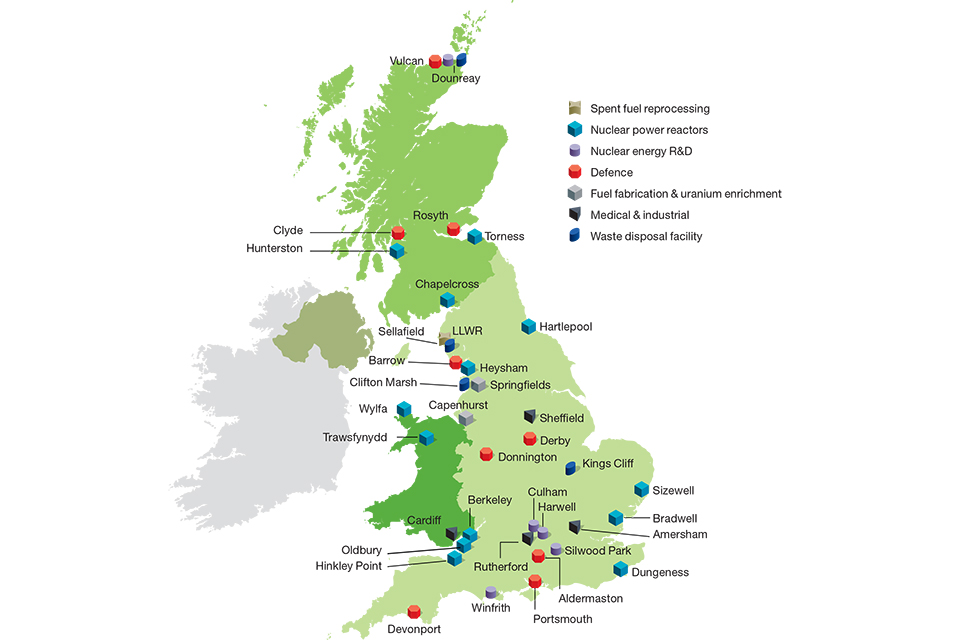
Don't build it near millions of people. See this map of the UK[2]; London, Birmingham, Liverpool, Sheffield are where the most people are, and where the nuclear power plants aren't.
3 Mile Island has not killed anybody AFAIK, but it showed the the world's leading tech nation failed completely in responding to the accident. Some facts could be found only years later when the reactor could be inspected and others will remain in the dark forever because they just could not be collected in time. You want to trust a technology where even accidents without fatalities cannot be investigated?
For Chernobyl the overall death toll is estimated between 50 and 4000. Nobody knows and nobody knows how to even count. How do you count the disabled and sick babies born after it?
For Fukushima 1600 fatalities were reported during evacution. I am not an expert, but I guess it's difficult to attribute because the whole area was devastated already by the tsunami.
There will be lucky outcomes also in the future. But if you have hundreds of thousands or millions of people around, some day we'll be out of luck.
So your nuclear power caused death count over 4 decades is roughly 5000 people? I think we killed more people than that trying to make a non stick pan.
> if Russia decides to cut off the gas they straight up have insufficient energy to make it through the winter.
I agree with your sentiment on massive incompetence regarding Energy policy but this is an exageration.
1. Russia won't cut off gas despite it's threats because gas is quite literally one of the few revenue sources for the Russian economy. Much like Qatar, Russia would implode without Gas money.
2. There are plenty of other gas providers Qatar, Norway, Algeria, even US/Canada LNG, who can sell to the EU.
What they likely won't sell is at the cost of Russian gas which is the pressing point for Central and Eastern European countries.
But the point is, you would shut down heavy industry and go into deficit before you were faced with a doomsday scenario of people freezing during winter.
Shutting down heavy industry is already a doomsday scenario. That would imply millions of people out of work and billions if not trillions of dollars of lost GDP.
> Russia would implode without Gas money
Russia can sell to China and India. US/CAN has insufficient LNG transport capacity to completely replace pipelines from Russia. Germany has insufficient import terminal capacity.
Yes, they wouldn't run out of gas, but the price would likely spike 5-10x and crater the EU economy which is equally as bad.
That is not quite correct. First of all, Russia cannot simply sell to China and India. It takes years to build the necessary infrastructure to do that.
Regarding import terminals: there are LNG terminals all over Europe that are far from their full capacity which all have connections to the German net. That alone would suffice in delivering enough LNG. Apart from that, we're on the fast track of having extra terminals ready by autumn.
Also price spikes as massive as those you mentioned will be prevented by emergency government regulation of the market (already announced).
As someone who works in the industry, I have a lot of confidence stating that we will be fine, thank you.
Last time this happened, during the financial crisis in 2008, Germany recovered remarkably fast. China is doing it due to lockdowns. Shutting some gas hungry indistries down over winter isn't ahlf as bad as it sounds.
>Russia won't cut off gas despite it's threats because gas is quite literally one of the few revenue sources for the Russian economy. Much like Qatar, Russia would implode without Gas money.
Russia literally shut down Nordstream today for at least 10 days.
Getting paid for gas in Euros or dollars they can't spend is worse than not selling it.
Planned maintenance announced with less than 1 week notice and within days of Putin doubling down on Ruble demands.
It is also worth noting that Gazprom has already stopped supplying gas to countries and companies refusing to bow to the rubles demand—Poland, Bulgaria, Finland, as well as some customers in the Netherlands, Denmark, and Germany.
I would entertain the possibility that improving or maintaining the existing standards of living is not a policy objective of most representative governments or their key donors.
Not sure the FX market is pricing that catastrophic risk and not simply low rates and high inflation. Why would only the FX market price it and not equities or German government bonds or vol markets?
Also, when markets generally go down, equity and FX positions are the first to be liquidated to shore up cash.
German companies have manufacturing presence all over the world, including substantial factories in the US. Those factories pay workers in dollars and sell products in dollars. They are somewhat isolated from the impacts of the EU failures.
German govt bonds are still being purchased by the ECB under QE so it makes sense their yields are suppressed.
Let me phrase it differently: I don't see the need to invoke catastrophic risk to explain current FX moves. I would expect a tail event inferred from vol markets to start with.
Increasing renewable energy sources and moving away from locally sourced fossil fuels and nuclear power have always been among the main policy proposals of Green parties.
Green parties did not win that much direct power, but they totally won the energy debate and their policies have become the mainstream consensus among European elites.
Over the past years, European governments (not just the German one) have been busy closing down any energy source that was not renewable or relied on imports from other countries.
Now it turns out that renewable energy sources are still not able to cover the basic needs of the population and the economy, and the dependence on imported fossil fuels has allowed an authoritarian government to launch the largest war on European soil since the World Wars.
I don't know if Green parties will actually face a backslash, but it seems clear that the energy transition in Europe will end up making the continent poorer and far less secure in exchange for little, if any, actual benefit for the environment.
That's just a typo. They tried to stop local non-renewable resources, only to end up having to import them from other countries at a higher price and with a larger environmental impact.
> Over the past years, European governments (not just the German one) have been busy closing down any energy source that was not renewable or relied on imports from other countries.
The German Green (Grüne) party is up in recent polls[0]. They are not just part of the German government coalition, with the posts of Secretary of Economy and Energy (Habeck) and Foreign Secretary (aka Secretary of State, Baerbock) (and some other posts), they are very powerful within the government coalition. Both Habeck and Baerbock are leading Chancellor Scholz of the SPD in polls since months.
It has to be said tho that the Green party is doing "realpolitik" now. While they aim at one hand to drastically accelerate renewables, right now they also invest heavily in getting a more secure energy situation in the near future still using a lot of fossil fuels, including rapidly building up LNG terminals and securing deals with parties they previously frowned upon, e.g. a gas deal with Qatar, the government of which the Green party previously heavily criticized for the human rights situation in the country. And e.g. they accepted - with some bickering - the temporary gas (as in petrol) price subventions the other coalition parties wanted, in exchange for temporary public transport price subventions (a 9-Euro regional ticket, that is valid for a month at a time, 21M sold by July 1, population 83M).
They are still rejecting nuclear power generation, neither wanting to build new plants, nor keeping old plants running (the operators of said old plants already called the idea of keeping those plants running "infeasible" to outright "stupid").
It remains to be seen what the blowback will be if inflation doesn't at least slow down, or if autumn and winter come and people start getting cold. Tho right now, the politicians and leading experts and "experts" say, it doesn't look like there there will be a shortage on a scale that gets life-threatening to some people.
[0] 20-24% share in recent polls, vs the 14.8% they actually got in the last election in Sep 2021. They are actually slightly ahead of the SPD (social democrats) in the polls now. The SPD is the majority partner in the coalition.
Effectively the only option they got. Nuclear is gone thanks to the Green party but also Merkel's CDU - who reversed the nuclear exit at first, thereby fucking up planning and investments into renewables, and then reversed that reversal after Fukushima.
The current government that has the Greens as a major coalition partner isn't really investing in new fossil fuel stuff, but replacements of existing fossil fuel stuff. E.g. the LNG terminals are meant to replace the capacity lost from ceased imports from Russia.
Building nuclear now isn't really an option anyway, at least not to deal with the current situation.
The operators of nuclear plants already signaled that running their plants longer is not an option. That would require a lot of investment, and more importantly a lot of time to renovate, modernize and re-certify these things. An effort I believe they said was in the range of 3 or more years.
Building entirely new plants, even with existing designs, would require at least 4 years even on a very expedited schedule.
So in the short term the only option is to keep using fossils - sourced from some place not-Russia. The Greens, while they certainly do not like that, understood this.
Would we Germans be better off if we had some nuclear plants left? Sure. But we'd also be better off if we instead had that energy mix that the Greens envisioned at the start of the century, that entailed renewables at the core, a bit of carbon (mostly from renewable sources, with tech to make it more or less carbon-neutral in totality) and storage, and investments (driven by government incentives) to use less energy in the first place.
If I had to blame anybody, it would be the 16 years of Merkel governments which managed to fuck up both nuclear and renewables, not the Green party.
Not really. Short term the German nuclear plants cannot be kept operational any longer. While fossils are bad, they are less bad than having none and getting old buclear planta ready when they are not needed anymore. Also, the fossil plants are there, and this cheaper to ramp up. Mid term, the goal seems to be renewables.
All in all, quite reasonable and well thought through under the current circumstances.
How can it not? Unless things can reverse fast (ie imported energy capacity that has left returns overnight) European home heating costs will skyrocket this winter. The average household will look for someone to blame.
They weren’t in charge of energy policy. In Germany for the last 16 years. They had completely different policy ideas to what was actually implemented.
Blaming the greens is internationally some kind of dumb idea that likes to reduce politics to stereotypes. The real effects will be much more subtle and indirect.
Could still end up with the greens losing votes. Currently it doesn’t look that way at all. (German perspective here.)
In Finland, the Greens actively and vocally opposed nuclear power at least up until recent years. They abdicated themselves from a coalition government in the early 2000's over that government's decision to grant a license for constructing an additional reactor at an existing plant. Rejecting nuclear power was definitely a visible part of their ideology. That part of the stereotype was actually true for a long time.
I don't know about Germany, but it is my impression that opposition to nuclear power was a common theme among the green movement in general for decades.
Obviously their agenda also included investing in renewables, as well as reducing consumption, but that wasn't going to happen fast enough, either for political or technological reasons.
I have voted for the local Greens several times over the last couple of decades even though I disagreed with and was frustrated with the views they held on nuclear power until recently.
I'm also unfortunately familiar with many of the common and overblown negative stereotypes towards the greens in general.
Insofar as nuclear power could have played a part in reducing our dependency on fossil fuels over the lasts couple of decades, though, I don't think it's unfair to say the greens in many countries did a lot to hinder that.
Electric energy =|= thermal energy. Nuclear energy solves the electricity part (which doesn't pose any issue at all), while doing nothing to aolve the thermal energy question. No idea why people, on HN of all places on the internet, fail to realize that simple fact...
Nuclear energy does not solve the heating part only because most of the existing nuclear plants have not been designed to provide heating, where gas heating was already in use.
There are many parts in Europe where the homes are not heated by gas, but by the waste heat from the local power plants, regardless whether they are gas-based, coal-based or nuclear.
Any existing nuclear plant could be converted to also provide heating for the nearby houses, if the infrastructure of plumbing for the transport of hot water would be built.
However, the last part of the heating infrastructure, where the hot water pipes would have to be passed through the house walls and through the walls of all rooms, would be extremely costly in comparison with an electric heater, even if the operating cost would be lower.
So it is very unlikely that such a conversion would ever be done to already existing houses, even if it is possible.
Heat pumps would have much lower installation costs, while still being more efficient than resistive heaters.
My argument is that nuclear is a different of energy compared to gas when used for heating. Sonce gas for heating is the tipic at hand, this distinction is quite important. And nowhere did I mention price. I talked about how converting electricity to heat is highly inefficient and will cost nore to heat the same building than gas. Nuclear only factors into that as much as it factors into a given electrical energy generatuon mix.
No, they have warned about a situation like we have it now for decades and were ignored by the conservatives and social democrats for the last 16 years.
They were right all along and are now the ones fixing the situation, after only recently being voted into government.
The polls show:
The two most popular politicians in germany are both greens.
They are the second biggest party in current polls with 22%, 6% behind the biggest party.
In the polls they are the biggest party in the current government (when the current term started a few months ago they were the second biggest party in the current government)
Things are going great for them and there are no signs of that changing.
While the strategy to let Russia sit on the table of grown ups did not work out in the end, I think it delayed Putins actions for a few years. I think Ukraine has much better chances than 5 years ago. And without the pandemic, it might have worked longer.
Trump was basically a clown saying different things for different audiences.
He said that we should be more friendly with Russia and that Russia has been trated unfairly. And then said we should buy more gas and oil from the U.S. What do you make of that? Why would you buy LNG from the U.S if Russia is such a great friend and its gas pipes are nearby?
Then went at great lengths to say how Europe is the biggest foe for the United States and not Russia.
Not to mention that fiasco at the Helsinky summit. If you talk a lot of nonsese people stop treating you seriously.
If I remember right he fancied NK leader as well. Just a clown or showmen or whatever you want to call him but definitly a reliable adviser.
Germany has been warned about its dependency on Russian gas by its EU neighbours and past U.S administrations long before that clown. It's just that Germany thought Russia is not completely stupid and made a risky and bad bet. Now it has to pay. It may be for the better because now it can invest in more renewables(i.e has a cleaner slate)


All of it a result of moronic politics around nuclear and a failure to build out fossil fuel capacity while the green energy transition was still in progress.