Reading the article, the view hinges on a gross mischaracterization: that a free speech environment has led to extremism and death. But this is absolutely not the case. First of all, the websites where the vast majority of extreme ideas are shared are not free speech environments. Second, the people who do bad things do it because they're damaged, or disillusioned, or some other personal motivator, the only difference now is that we can read and understand their view (not implying that we should be sympathetic, only understand even if we vehemently agree).
Another point I have a bit of a gripe with is that the person fails to point out the misdeeds associated with the ideology he (probably) is more sympathetic towards. Interestingly, the view that people should not be able to freely share ideas with one another and judge ideas on their merit with their own cognitive capacity seems to be common among those sympathetic to this ideology. I wonder how the author feels about those people controlling the environments where discussion happens and policing discussion on extreme topics sympathetic to themselves.
Why, yes, free speech does help spread all ideas, including those which lead to death.
The only truly safe environment is a very strict prison where inmates are not allowed to do basically anything, because anything can be risky and ultimately lead to death. Ideally, thinking should also be restricted for the same reason.
Danger cannot be removed from trying new things and learning unknown things. Danger, suffering, and death are inseparable from any progress.
So it goes. Don't try to make an environment too safe, because it's inevitably stifling.
Of course, every individual extremist has their own story, but we are also all products of our environments and it is clear that the web creates an environment in which extremism thrives.
Personally I think free speech is worth it but we can't pretend there's not a cost.
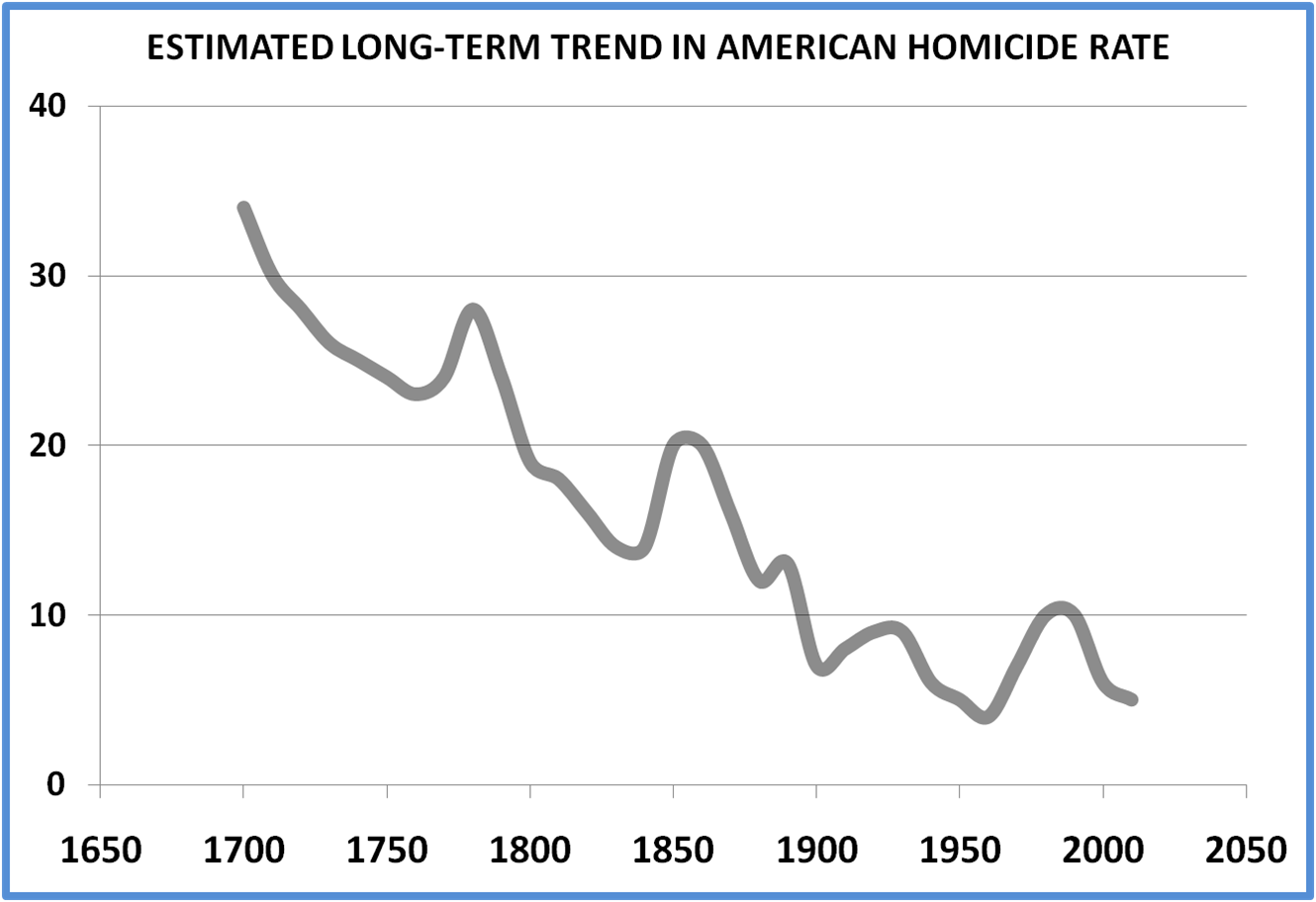
The free speech web has created the most peaceful least violent society in history. Censors on the other hand are found constantly endlessly and relentlessly at the vanguard of the bloodiest most extremist movements of all time.
What is this cost exactly? Censors have shown an utter and complete lack of evidence that censorship reduces violence whatsoever when you look at the long run and broader picture. They also love destroying the economy as well as art. Censorship at the end of the day always ends up being a particularly evil form of power politics regardless of the noble intentions it sets out with. Outside of a very narrow scope of things that ought to be censored (calls to violence which would include 8ch, defamation, fire in a theater, etc)
> Censors have shown an utter and complete lack of evidence that censorship reduces violence whatsoever
That's because the scale and untracked nature of such noncensored sites make their impact difficult to quantify. We know that social contagions exist, but we don't know the extent to which they affect people.
School shootings are far, far more common than they used to be. They started to really rise around the same time that sites like 4chan glorified the shooters and discussed the issue like it was a game. They spoke of becoming an hero(sic), talked of getting a high score, and made memes of their dead bodies.
The world tends to loathe extremes. We know that extreme censorship causes social issues. Why wouldn't complete non-censorship combined with anonymity cause issues too?
the world is roughly 100000% less violent than it used to be, and the violent crime rate has not increased much in the past 5-10 years. this is a total lie.
This isn't a lie, but it's also more nuanced than this. The world has been seeing a massive decrease in poverty. At the same time, only something like 4.6 billion people have internet.
I'm not saying that social media causes a flood of violence, I'm just saying that there are violent social contagions that should be addressed. Think of ISIS's social media campaigns for recruitment.
>In any case, hateful let's-do-a-genocide ultra free speech didn't help.
Absolutely it did. We get to see who the crazies are. We get to see what extremist ideologies threaten our peace. We get to talk to people that hold those ideologies, understand them, sometimes demonstrate the error in their view and sometimes simply prepare for them.
They exist whether we hear their voices or not. It's better to hear their voices than not.
I start wondering if you've gotten your worldview messed up
That you over estimate how dangerous various ideologies are
Compared with traffic accidents, and possible worse, those who sometimes get elected as presidents in your country.
I'm wondering if the places on the internet you apparently visit, slightly have brought you into a fantasy world now, where you worry for and want to prepare for the wrong things. I'm wondering if you believe you need weapons to defend yourself? Whilst being less interested in climate change and wildfires?
> In any case, hateful let's-do-a-genocide ultra free speech didn't help.
have you read 1 thing by any political revolutionary of the past? ones you like. washington. lincoln. malcolm x. rosseau. they're quite violent, and would get censored by your 'lets-do-a-genocide free speech' laws.
Not "web" but the "attention economy" which tries to lure users into echo chambers and raise outrage in these chambers, so that the users spend more time there and click more (political) ads.
Stay away from the outrage machine. Be polite. Assume your partner in a dialogue is neither a fool nor malevolent. Quench flames. Try to understand, not to prove you're right.
> it is clear that the web creates an environment in which extremism thrives.
No, it's not clear. Please elaborate.
The strongest weapon against extremist ideas is other views on the issues that created the extremism in the first place. Most extremists don't want their people to communicate freely, for a reason.
Your argument presumes that the natural tendency of the web is to foster a free and open market of ideas, rather than a system of closed echo chambers each inhabiting distinct realities in a post-truth landscape.
That by no means seems to be a sure assumption today. If anything, the question now is whether the latter state of affairs might not be the default, and if so, whether it is reversible at all.
Just like people, not markets, create deadweight loss, rent, and negative externalities, and people, not institutions, cause systemic racism? /s
The web is a complex system that is more than capable of producing outcomes that are drastically different from the sum of its inputs (i.e. "people"). Based on what kinds of mechanism design and incentive structures are put in place, it is not only probable, but more mathematically likely that even a web filled only with rational correspondents will eventually devolve into a mess filled with falsehoods and echo chambers.
The important corollary to this insight? There's an entire class of structural remedies we can take that you're not even considering, before we even approach anything remotely resembling censorship on the individual.
You're talking about the "social media" in specific and not the web in general. Yes, social media create echo chambers, that's what they are for. The web never did, it created search engines to find arbitrary content, self-published blogs, online courses, Wikipedia etc. etc.
The web most certainly supported bubbles: who you link to has a huge impact on where readers go next and the language people use affects which results they get for searches (even before Google started personalizing things based on your past history).
It was slower than Twitter/Facebook but the effect is exactly the same as the social media problem. I have a relative who went down the conservative conspiracy theory rabbit hole in the years after 9/11 and the web was a huge accelerant for his intellectual decline because once he found a community of fellow travelers he’d stay in that network of blogs where they strenuously resisted outside sources or the general idea of objective reality. When those communities moved primarily onto social media, they moved faster and got wider range but the practices didn’t change at all.
You are arguing that the choices the web offers result in bubbles because some people choose to stick with particular types of content after discovering it through links. The web however offers just as many ways out of bubbles and there is no better remedy than this freedom. Your relative would not have been saved by a "nanny web" strictly policed by authorities, he would have stayed in a social bubble of personal relationships where the information choices available on the web are inaccessible. It's how extremism thrived before social media.
Having such freedom available is of no use if people won't make use of it. You assume a "nanny web" is about taking away these freedoms, when in fact it's about incentivizing people to actually utilize them.
I agree with you insofar as Mill's free market of ideas is the best remedy against bigotry and extremism, but you have the wrong idea about how to achieve that -- unregulated laissez-faire "freedom" on the web does not result in actual free discourse. On the contrary, that's just a recipe for a web overrun by all manner of adware, malware, spyware, propagation of unconscious self-censorship by means of universal targeted and mass surveillance, and straight-up disinformation ops and public opinion manipulation from hostile actors. How are you going to have sincere exchanges of ideas at scale over all that noise?
People are just as free to follow diverse viewpoints on social media but for many people that’s not the point. They want that bubble and are determine to avoid it. That doesn’t change with the choice of forum.
Similarly, there’s not that big difference on “policing” - the social media companies enforce very basic terms of service but most people use web hosts with relatively similar terms. The major difference is the discovery mechanism (and the fact checking applied to certain politicians’ accounts which aren’t banned on public interest grounds) which is closer to how search engines avoid sending links to certain sites with bad reputations. A lot of what Twitter/Facebook block will also be dropped by Google or many free web hosts. You can definitely get away with more but I don’t see much reason to believe that it’s a major difference rather than minor variations depending on which companies and content you’re talking about.
There's a possibility that if instead of discussing and debating ideas we disagree with, we repress them and try to bury them, it will just form a darker, more extreme underground network. Extremism isn't some new thing. Right now certain political viewpoints are allowed to be discussed and others are not. The Overton window is very small. That leads people who disagree to try to find each other and band together, form some kind of opposition. Because their opinions are repressed, they stay insulated in their bubbles (as do people with mainstream opinions). The isolation leads to extremism.
If you look at the polarization of politics in the united states, both sides hate each other and they won't talk. Maybe if there was some kind of discourse, things wouldn't be so bad. Right now the only words exchanged are insults, all republicans are alt-right, all democrats are communists. It wasn't always like that. It used to be possible for people who vote differently to be friends, or even live in the same household.
That is exactly right. It also gives them an intellectual martyrdom card and a veneer of coolness. If you want the next hip counterculture that all the kids are into to be Naziism, by all means suppress it.
Nazis don’t deserve to be handed the “2 Live Crew effect.” For those who don’t know this was a mediocre booty rap group whose record went triple platinum after attempts were made to ban it.
A parent poster raised another great point: the echo chambers that are full of this toxic stuff are themselves not free speech zones. They are heavily moderates safe spaces for specific ideologies and cultures. I am not convinced that this stuff would fare so well on a level intellectual playing field. It’s asinine.
On a final note it’s important to point out that the original explosion of e.g. Qanon happened not via some decentralized free speech zone or even the chans (where it was always ironic or a prank for most) but on social platforms with algorithmic timeline.
The algorithmic timeline is what has really ruined online discourse and promoted an explosion of insanity. Discourse on these sites is not equals but is weighted toward what will maximize engagement. Trolling, demagoguery, shock mongering, and various forms of “porn” (outrage porn, fear porn) are what maximizes engagement.
The algorithmic timeline would be extremely hard to implement in a decentralized system. That’s perhaps a good thing. It might look more like the genuinely flat forum world of the old Internet where discourse was comparatively far more reasonable.
> The algorithmic timeline is what has really ruined online discourse and promoted an explosion of insanity.
This is a really good point. I think it's important to point to this as the root of the problem, and realize that what's good for Facebook and Twitter isn't what's good for society.
I think a lot of this debate is on false premises. It’s not free unbiased media vs censorship but a debate over different kinds of biased media. All social platforms that implement any form of gamification or algorithmically weighted presentation are absolutely not neutral and will tend to promote whatever best satisfies the algorithm or echo chamber effect (in the case of gamified forums).
If the goal of the site is to maximize engagement, that’s going to be extremism, edgelording, porn, and trolling.
The algorithm has absolutely no way of knowing what I want. It can only guess by looking at what I've viewed, and the real motive is always to keep me on the site and maximize engagement.
As I said: negativity maximizes engagement.
Let me give you a simple example. Lets say I walk past you on the sidewalk and say hi. Not much engagement. Now lets say I walk up to you and punch you. I have just maximized engagement. Which is a better interaction?



Another point I have a bit of a gripe with is that the person fails to point out the misdeeds associated with the ideology he (probably) is more sympathetic towards. Interestingly, the view that people should not be able to freely share ideas with one another and judge ideas on their merit with their own cognitive capacity seems to be common among those sympathetic to this ideology. I wonder how the author feels about those people controlling the environments where discussion happens and policing discussion on extreme topics sympathetic to themselves.