These APU's wont fix todays problems in Laptops. Idle power consumption is largely due to all components together. bigger batteries are only more expensive. I'm still waiting for more efficient SSD's. There's no point in an efficient SOC if you still need a large hard drive and a bright display.
And of note; an 1800 base freq is on the low end of the performance/watt curve we've seen from their other products. Maybe AMD expects most workloads to not use all 8 cores properly and let the boost algo max the cores out?
also, where's PCIE 4? My guess is they are waiting a cycle on purpose due to power constraints.
> And of note; an 1800 base freq is on the low end of the performance/watt curve we've seen from their other products. Maybe AMD expects most workloads to not use all 8 cores properly and let the boost algo max the cores out?
The 1.8ghz base freq is just to hit the desired 15W TDP. The approach is pick a TDP, say 15W, then adjust base freq for the core count to hit that. That's why the 8C ends up at 1.8ghz base while the lower-end 4C has 2.9ghz base freq. Then let turbo be the thing that everyone actually uses on a daily basis, because base frequency is irrelevant. It's not actually an input into anything the CPU does for either AMD or Intel. The CPU is monitoring its power draw to stay in a power budget and a temperature budget. What speed it ends up running at is then not just dependent on how many cores are used but also what type of instructions they are running. It's a fully-dynamic system these days, making single-number specs useless.
All AMD Ryzen chips, even the cheapest $50 3000G (technically branded an 'Athlon') are fully unlocked and you can adjust everything to your hearts desire.
Unlike Intel, AMD does not charge extra for unlocked chips.
It's not like it matters tho anyway: with Zen2, PDO2 pretty much pushes your chip up to the limits of thermal constraints. I'm looking at Ryzen Master right now, and my TDP is "1000W".
Given this is a laptop it doesn't really make sense to adjust the TDP even if you can. You're going to be limited by the laptop's cooling solution, which is going to be at best sufficient for factory settings but nothing more. More commonly it's actually not quite sufficient for factory settings, leading to thermal throttling over sustained loads.
Oh I am well aware. Laptop coolers are barely good enough, without exception. It's fascinating really, it's like they want their systems to run at close to throttling temperatures, so they last a tad bit longer than their warranty.
Doesn't bother me, I've got 2 hands and 2 eyes, anything can be modified with those. Except encrypted BIOSes, for now :D
SSD efficiency would be the thing that's nearly irrelevant. What even stresses the disk at all in a typical ultrabook workload?
Under load though mobile CPUs hitting north of 40W makes them, along with the GPU, the most power-hungry component by a lot though. Display power is like 5-10W at "normal" brightness levels.
"Under load though mobile CPUs hitting north of 40W"
Most ultrabooks feature 15watt parts. They might hit 17watt but will definitely throttle after that. Yes, if you buy a laptop with a high tdp part like 35 then yes, it will consume the most power.
My problem is that idle power consumption is what mostly dictates battery life. and the APU wont always be in C0. Especially when doing mundane things like a powerpoint presentation or watching a movie. in those cases the CPU consumes only around 5-8W on todays mobile processors. Like you said, the screen brightness is already at 5-10 watts. Factor in that you're either streaming a film from netflix, adding another couple watts for your ethernet or wifi chip. Or you're streaming it from your ssd. Meaning your ssd will be kept out of its lowest power state and also consume a couple watts on top of all your other components.
Unless you're rendering for hours on your battery, your CPU wont be the top contender for power consumption.
"SSD efficiency would be the thing that's nearly irrelevant." you'd be suprised. most hdd's are still more power efficient than flash storage. Especially the bigger capacities have active idle power consumption of 1.5w that is, before we're adding any reads or writes to it. Yes, ssd's can power down but its not a silver bullet.
>"SSD efficiency would be the thing that's nearly irrelevant." you'd be suprised. most hdd's are still more power efficient than flash storage. Especially the bigger capacities have active idle power consumption of 1.5w that is, before we're adding any reads or writes to it. Yes, ssd's can power down but its not a silver bullet.
You will need data to prove your point, Most Laptop SSD has idle power and active power lower than HDD AND faster read write response time hence much quicker to idle power state.
i.e SSD energy per workload is significantly lower than HDD.
I dont have perfect apples to apples comparisons but I can paint you a pretty good picture. Idle active power consumption is mostly determined by the controller and the amount of RAM on the device. read and write energy costs are very difficult to determine (for someone not working at samsung) First of all, almost all old ssd's beat new ones in power consumption. which makes sense as the controller needs more energy to read smaller and smaller tlc nand. especially the move to NVME drives. You can see that here
https://www.anandtech.com/show/9702/samsung-950-pro-ssd-revi...
The idle power draw is also specified in the spec sheet. Its why I didn't bother with data. The evo drives dont have as much ram and a more forgiving controller. they are along the 0.5w lines I think
So just how do these drives compare to hdd? and how do they consume power on everyday tasks? I dont have any articles of modern mobile hdd's because they kinda went out of style. But one article gives you the best case scenario
https://www.tomshardware.com/reviews/ssd-hard-drive,1968-10....
Old, low capacity, sata flash drives. They are the most power efficient devices. Hopefully anantech or tom's hardware will retest NVME drives in laptops to hit the final nail in the coffin for nvme ssd power consumption compared to disks.
Sigh. This is HN, not Anandtech, there are people here design SSD Controller and Firmware for a living.
>The idle power draw is also specified in the spec sheet. Its why I didn't bother with data.
Which is why you should check. I should also remind you Laptop SSD are tuned with energy usage in mind rather than performance.
A modern 970 EVO desktop NVMe drives idle at 0.03w. You are off by a factor of 10.
The same drives has a deep idle state of 0.005W. Your idle Power is off by 100x.
Let's Assume a Laptop HDD has a similar idle and standby power. ( Which they dont )
The same drive compared to HDD has a Seq Red 10x and Random Read of 1000x to 100,000x. Let pick a middle of the pack number as 100x.
Even if Active power of SSD were double of the HDD ( Which they dont ). In Mix workload SSD is faster than HDD by 20x, SSD would have saved 10x energy.
>NVME drives in laptops to hit the final nail in the coffin for nvme ssd power consumption compared to disks.
There is nothing final nails in the coffin. The difference is so drastic, and there is a reason why every laptop manufacturer jumped to SSD. Not because it was cheaper, but it saves huge amount of energy hence battery.
That "15w TDP" is just the limit it will sustain. It regularly spikes over it, and by a lot, for 10-30 seconds at a time.
Or in Intel's technical terms the spec that they provide is the PL1 TDP. The spec that they don't provide is the higher PL2 TDP. Turbo is initially governed by PL2, not PL1.
> Especially when doing mundane things like a powerpoint presentation or watching a movie. in those cases the CPU consumes only around 5-8W on todays mobile processors.
And per the anandtech link you provided Samsung's specs for the 950 Pro NVME drive mention 70mW idle and 2.5mW DevSlp power draw, and anandtech measured idle power draw at 20mW.
This puts CPU power draw at 100X larger than the SSDs in the simple video & powerpoint presentation use cases.


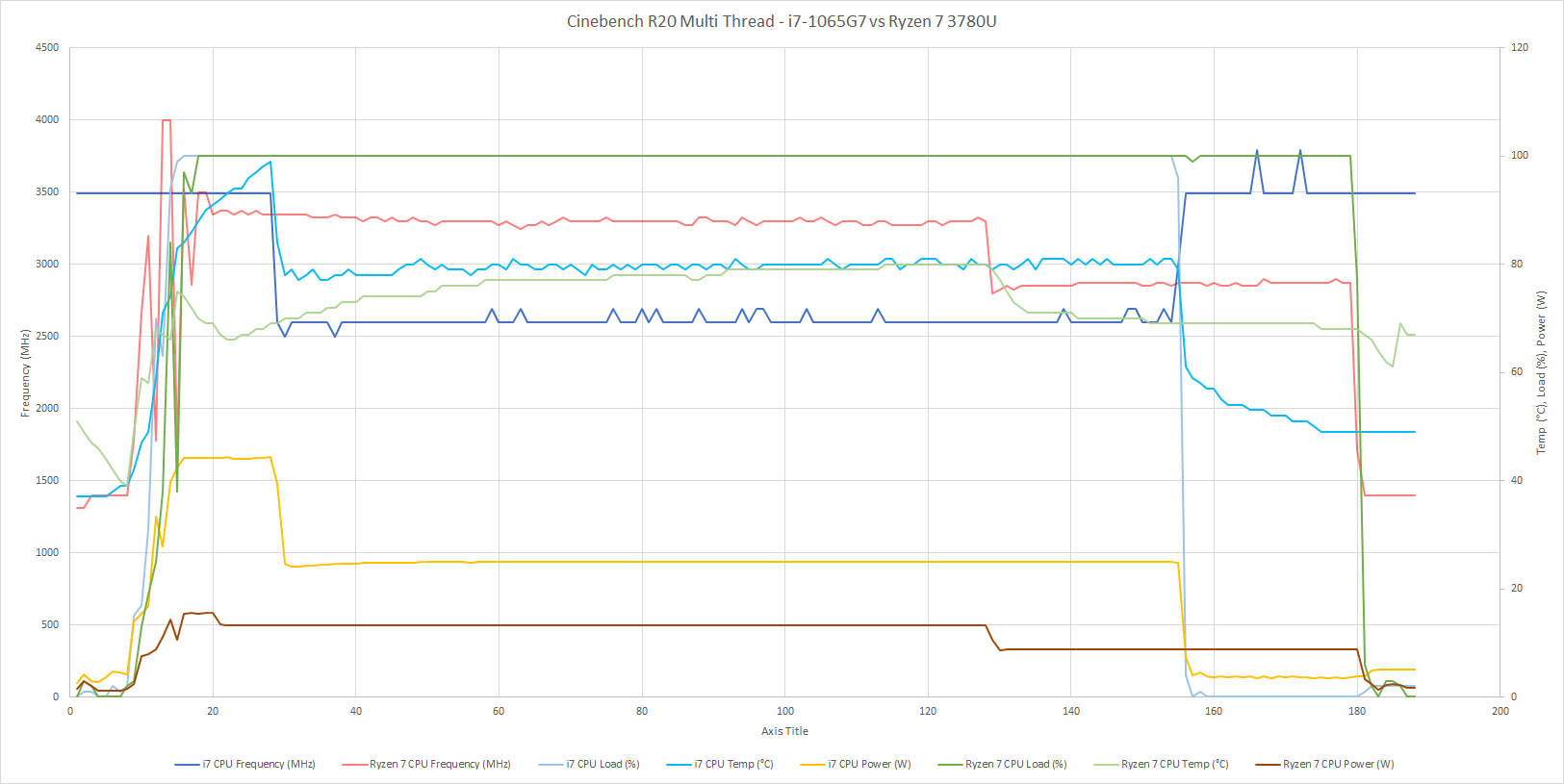
And of note; an 1800 base freq is on the low end of the performance/watt curve we've seen from their other products. Maybe AMD expects most workloads to not use all 8 cores properly and let the boost algo max the cores out?
also, where's PCIE 4? My guess is they are waiting a cycle on purpose due to power constraints.