Yes, we have our problems, but India and China do too. We have Iraq, they have Pakistan and Tibet. We have a falling dollar and a mortgage crisis. They have overcrowding issues, a transportation crisis, and environmental problems (to say the least)... I don't know about you, but the emerging middle class in Asia and the Middle East just screams instability to me.
The US on the other hand, will continue to provide a low risk and relatively stable environment for investing, especially if we can figure out a way to strengthen the dollar. (Though we've heard interesting theories on how it could rise naturally as exports become less expensive to foreigners and imports become more expensive to us. Domestic savings would rise, economic growth, etc.)
On a sidenote, I don't understand how Philip can truly believe universities in the US are inferior. I thought everyone was in general agreement that we had the best universities? I even personally hang out with a Saudi student who comes from Middle Eastern oil money. He could afford any school in the world, and he chose little SMU in Dallas... Would Philip consider MIT or Harvard inferior? I wish I could go to MIT or Harvard...
Overall, the article brought an interesting idea to the table. I just have trouble seeing growing economies in India and China as a bad thing for the US. I don't like how some Economist's love to bring India and China into the mix only to instill fear.
I think the best universities in the US are better than the best universities here (Netherlands), but the worst in your country are worse than the worst here. All universities in the Netherlands are good, but we don't have any exceptional universities. This may be my limited judgement, but I've not even considered stuying computer science because of the curricula here.
People are buying more in the US because of the low dollar. I buy more cheap books on amazon. You are probaly importing less because it's expensive.
He didn't say anything about US universities. Here's what he wrote:
"Our college graduates are roughly equivalent in ability to other nations’ high school graduates, and a lot of our high school graduates could not compete on the world market for any jobs other than manual labor."
You'll also note that he cites an article to support the premise. That said, having taught a few senior-level courses at a top-tier university, I think he's right. The quality of undergraduate education at most schools is abysmal, especially large public schools.
Top US universities are best known for their research programs, not their teaching. (Thanks to drastic cutbacks at the NIH and NSF, even that lead is threatened, but that's another story....)
Articles of this kind always confuse me. Is the thesis that the US is now an unfavorable destination for money? Putting aside currency and liquidity flows, which also confuse me, how about talking about economic activity as a barter system where paper monies are convenient proxies for a million linked IOUs. We all produce a bit of something and trade with it. Now it seems like the author is likening the US to that guy who washed ashore on an island inhabited by two others who have already captured all sources of food, shelter, and entertainment between them and trade in a perfect harmony. The guy who washed ashore, having nothing to offer, will die. However, comparative advantage suggests that even the entity that is not foremost in any activity can eke out a living by creating/manufacturing the stuff that has the lowest opportunity cost of production? Metaphorically speaking, the US will at the very least get to ask the others if they want fries with their fish sandwiches. And that is in the bleak scenario that the US slips overnight into a sweeping mediocrity in all fields.
This is hardly true. Despite many legitimate concerns, the US is a definitive leader in pharma, entertainment, technology, and education.
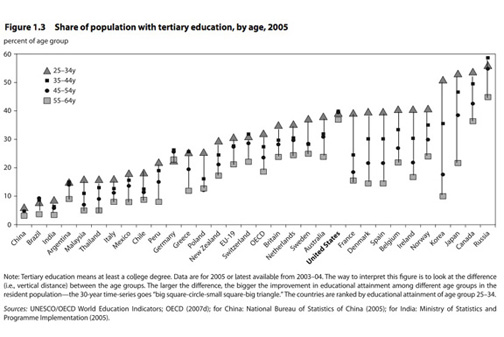
"Our college graduates are roughly equivalent in ability to other nations’ high school graduates (story) and a lot of our high school graduates could not compete on the world market for any jobs other than manual labor." This statement is misleading, the US happens to send a very large percentage of its population to high schools and colleges. The median student is, of course, not going to be as smart and able as the median student in India where only a really really tiny percentage of the population has set foot in a classroom.
Even the percentage shown in that graph is probably over counting using a very lax definition of college: I say this not as someone speculating on the basis of some internet research, but as a product of the Indian schooling system.
And, this might be a stretch, so what if the average graduate is not as smart and intellectually competent in a narrowly defined sense? We became soft and pudgy after physical prowess stopped determining survival probability and reproductive success in industrial and post-industrial eras, so what if we (on average) do become thicker in the post-information era where we have cognitive aids for almost all functions?
I think the college years in the US are partly similar to the senior years of what other countries may call senior high (it is that way in Australia) - generally that would be an exageration though to say that they are equivalent - and its kind of just a terminology thing. College does go further then seniour high though. End result of a university degree would be comparable I would think (for an undergrad) - on average (of course the US has outstanding top end universities which probably don't compare, or if they do they compare to very very few unis around the world).
> the US is a definitive leader in pharma, entertainment, technology, and education.
The technology claim is a bit dodgy. The US runs a net trade deficit in all categories of scientific and industrial equipment. The US has a few pockets of highly valued intellectual property, but even this edge is slipping away. Pharma has big profits from activities in the US, because Americans have turned sedentary gorging and subsequent suicide pill popping into a subsidized national past-time. I wouldn't put this under the "strengths" category.
The US is not a metaphorical man on an island. It is is a nation of wage earners. The best way to thing about the big picture situation is to simply observe that 200 years ago the average working man earned more or less the same wage anywhere in the world. Then the West shot ahead. Now this disequilibrium is being corrected, and it's fairly easy to argue that real wages in the West will fall and it won't be rising wages all 'round. There isn't sufficient iron in the earth's crust to support the car owning standard of living the whole planet now aspires to. As global wages rise, Americans will be priced out of their current standard of living.
In case I was a little too indirect for you, that was not an ad-hominem attack, it was a criticism of the article disguised as an ad-hominem attack.
And as I said in a comment on Philip's blog, all of the stuff he is talking about is priced into the exchange rate. And since the dollar's value has dropped drastically in the last few years, the US has been a terrible investment for the last few years. Going forward, it might not be so bad, because all the bad news has been priced into the exchange rate (perhaps).
I had lunch with Mr. Greenspun once upon a time. I remarked after, that it was amazing how he managed to insult all seven nationalities at the table in an hour long lunch. But his writings before the Ars-Digita blowup and subsequent settlement were much more enjoyable because they had a "call to action" of sorts. Things were crappy, but you as an individual could make a difference.
Now his writing is basically "the world is screwed, and Americans are morons for not realizing it."
I'm calling FUD. There's a lot of press out there talking about what rough shape the economy is in. It makes for good copy, and it sells ads. But ultimately, I think we're just in a correction.
Iraq: We've got to stop spending money on it period. I agree. It's just silly and artificially inflating oil prices.
Dollar devaluation: It's actually a good thing for the US economy and the US consumer, but it's going to cause the rest of the world to suffer a bit. A weaker dollar means that US goods will be cheaper relative to foreign imports. This will be good for the US tourism and manufacturing sectors. Cheaper US products, mean that more people will buy them over seas. Other countries are going to have a harder time selling to the US, because their products just went up 30% in price because of the exchange rate. The dollar is being devalued on purpose in my opinion. It's the only way to correct the trade deficit.
Expensive Oil: This is going to make us tighten our belts, and it will spur growth in other energy sectors aside from fossil fuels, which in the long run only makes sense from a geo-petro-political perspective and a environmental perspective. I'd love for oil to be at $200 or $300 a barrel. There'd be a lot more economic incentive for electric cars and nuclear power plants. Short term pains, long term gains.
US schools: I don't see tons of US students going to Europe, China or India to study. I still see many students trying to get in to US schools, however. And, it's not so much the quality of education available, it's that pretty much anyone can go to any school (aside from the 20-30 highly selective schools). Education in other countries is heavily subsidized, and it's hard for people to go back to school. In many countries, you're told what schools you can attend, and what majors you are able to take. You don't have the flexibility that we have here. It's one of the essential strengths of the US economy. I've been an ER nurse for 14 years, and I'm going back to school for software engineering. I've attended the University of Maryland online while moving to 2 different states and 4 different cities. I haven't heard of any other country that has that type of educational flexibility. I work with a number of nurses that use to be engineers, or flight attendants, or ministers. The average US worker has 7 different careers in their lifetime. You simply don't have that fluidity in other countries. It's that fluidity of labor markets that gives the US a big part of it's edge in the international market.
Foreign investment: If a US company invests in a manufacturing plant in India, and the Indian manufacturing plant succeeds, where do the profits end up? On the balance sheet of the US company.
Foreign competition from India/China: I have a friend who's job is to ship servers to India/China. The bureaucracy is so convoluted, it takes them 2-6 months to get a server or a SAN through customs. Many other countries aren't used to working on Internet time. I have another friend who worked for Big Internet Co. here in the valley, and he's planning to leave to go back to India in the next 2-3 years. He says that salaries are pretty much at a parity, when you compare the costs of living. In other words: outsourcing is no longer cheap labor, it's just finding available engineers.
US as a bad place to invest: Okay, when you buy a stock, say GOOG. Do you want to buy your shares of GOOG stock when the price is at $800 a share and hold it, or do you want to buy those shares when it was at $87 a share? You want to buy it at $87 a share because then the price will appreciate. The idea is to buy low and sell high. Too many people buy when there's hubris and giddiness in the press (e.g. buy a house in 2006 or Internet stock in 1999) and sell when there's panic (e.g. sell a house today or tech stocks in 2001). Phil is falling in the same mistake. He's encouraging people to sell their US stock when it's low. This is a great time to invest in the US. It's a great time to be here. It's a great time to buy a house, if you can afford it. Why? Because things are going to appreciate after all this FUD dissipates.
Finally: Compare the number of posts on Hacker News and elsewhere that say: "How do I move to India/China/Europe to start my startup" vs "How do I move to the US to start my startup"?
> Dollar devaluation: It's actually a good thing for the US economy and the US consumer
I agree with everything but this claim about the falling dollar as a benefit. The falling dollar is a way to default on international debts. It is also outright theft from those who have saved in dollars.
This idea that a falling currency means boosted exports is empirically challenged. If you measure in terms of the devalued currency, then yes, more money is received. But it's money that is worth less, so the change is essentially meaningless. In terms of actual physical exports, with a couple exceptions, falling currencies have not boosted manufactured exports in industrial economies. The more obvious historical correlation is a trade surplus and a strong currency. A falling dollar will probably boost the share of existing commodity production that is exported more than it will stimulate new manufacturing. That is a bad thing in that it basically means Americans are finding themselves outbid on their own crops. It means people eating less meat because they can't afford it anymore.
* The falling dollar is a way to default on international debts. *
Isn't that what third world countries have been doing for decades? :)
I hadn't really thought of the increase in export volumes would essentially be zero sum because of the fall in value. Good point.
I don't know. I've been of the impression that the US dollar has been overvalued for quite some time, however. You can't keep running the trade deficit's that we've been running for decades, and expect the dollar to stay strong.
Essentially, what I think is happening, is that the whole world has been running up the prices on the Dollar for decades by using the Dollar as a benchmark and holding currency. And, now the market is correcting itself, and buying the Euro instead. The Dollar has never really had a decent competitor until the advent of the Euro.
While I certainly don't think that it's going to be good for us in the short term, I do think that it's going to knock some financial sense into us. We've been living on credit cards for far too long as a country, and now we're going to have to pay off the credit card bills. I'm okay with that.


Yes, we have our problems, but India and China do too. We have Iraq, they have Pakistan and Tibet. We have a falling dollar and a mortgage crisis. They have overcrowding issues, a transportation crisis, and environmental problems (to say the least)... I don't know about you, but the emerging middle class in Asia and the Middle East just screams instability to me.
The US on the other hand, will continue to provide a low risk and relatively stable environment for investing, especially if we can figure out a way to strengthen the dollar. (Though we've heard interesting theories on how it could rise naturally as exports become less expensive to foreigners and imports become more expensive to us. Domestic savings would rise, economic growth, etc.)
On a sidenote, I don't understand how Philip can truly believe universities in the US are inferior. I thought everyone was in general agreement that we had the best universities? I even personally hang out with a Saudi student who comes from Middle Eastern oil money. He could afford any school in the world, and he chose little SMU in Dallas... Would Philip consider MIT or Harvard inferior? I wish I could go to MIT or Harvard...
Overall, the article brought an interesting idea to the table. I just have trouble seeing growing economies in India and China as a bad thing for the US. I don't like how some Economist's love to bring India and China into the mix only to instill fear.