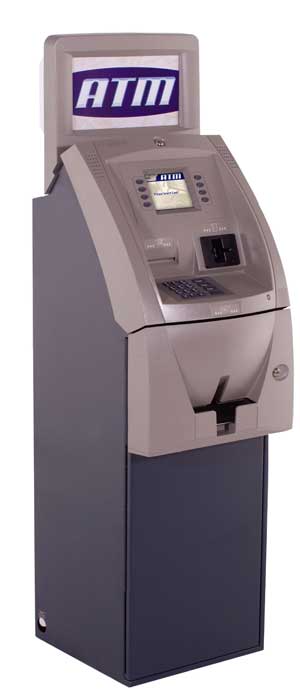
To be fair, drilling a 3 inch hole in a modern ATM is no easy task. We are talking about high-grade steel, a layer of fiberglass, etc. Hence "portable power drill" is a bit misleading.
Maybe some of them are. Ive also found some that are crap.
I have a tendency to pull on things like ATM covers, credit card slots, and the like. And that's because we have lots of skimmers that are found at local gas stations and places around here (big college presence).
So far, I've found an opened gasoline pump door. I called attendant and went to a different pump (attendands didnt have keys for that....) .
Ive also found an ATM that was partially locked and came opened when I gave it a tug. I called our bank's security after that one.
I also found a skimmer on a gas pump as well. It had a fishy look to it and gave it a tug. Pop. Was just a simple card reader and cam module in 1. I harvested the parts and put the microsd card through a good format.
This worries me, especially given some locations take your card and swipe it for you. I'm going to be checking these types of things more closely from now on... It is kind of sad, how difficult it is to educate the public on scams such as these.
Location surprisingly has less to do with the possiblity of it happening than one might think. There was a huge scam in Silicon Valley with card readers stuck inside of gas pumps so they were undetectable, that started five years ago. http://sanfrancisco.cbslocal.com/2014/02/21/six-arrested-for...
I'm on the -announce list so I get the occasional e-mail but, TBH, there really isn't much that interests me. I haven't been to the place on Rogers but I did visit the previous place (off Curry Pike) several times (I started a class there but "dropped out" after a few weeks due to work/travel).
Perhaps I'll drop by the new place some time, though.
I own one of these. It's inside a building that would be closed when no staff were around, and it doesn't ever contain enough money to be worth it to most people.
I wouldn't leave that thing at an outside location with enough money in it to hurt me, unless the robberies were insured or so seldom as to be considered a cost of doing business.
Where the are drilling, next to the keypad is usually some kind of thin sheet metal or plastic or combination. The 'top' part of the ATM (which houses the PC running it, the cables and a bunch of other electronics) is usually extremely insecure (wafer locks you can pick, flimsy construction).
The hardened part of the ATM is only the safe (which, by design, actually has several large holes in it as well).
You won't be casually drilling through the safe with a hole-saw or other portable equipment without spending a considerable amount of time.
You cannot casually drill a safe. Not talking about your hardware store variety of safe, or a 'fireproof safe'. But a legit safe like you'd find in an ATM has a number of countermeasures to ensure that its not possible to drill the safe in a short amount of time.
Mixed into the steel is usually a number of drill-bit-breaking things like hardened ceramic/steel ball bearings, odd shaped chunks of metal, plastics which all react differently to different attacks in order to ensure that one attack does not compromise the door and that its near-impossible to do quickly.
Bigger safes employ the use of fancy mixtures of concrete and metal to resist even more aggressive attacks like thermal lancing etc by turning the whole door/wall into a giant heat-sink.
I can understand how it's possible to design quite strong small safes. But what about big bank safes? Are the same design techniques used?
If not, why bother going through the front door? Isn't that door mostly for show? Aren't the other five sides mostly concrete and rebar? Isn't that easier to go through? Or do big safes really have thick steel on all six sides?
Depends on design and cost. Your thinking of a vault. Vaults have a solid door (as described above) and essentially its layers of security. The other 5 sides sometimes are the weakest point, but will still take significant amounts of time to penetrate on any properly designed vault.
No point in putting an extremely expensive vault door in a room that's got just concrete and re-bar.
The other thing is to make it harder to access those other walls as opposed to the front where you can walk up to it.
Drilling through the generic zinc pot metal that everything that can't be made of plastic seems to be made of nowadays could leave one with a wildly inaccurate idea of how difficult it is to drill in hardened steel.
Sure there is. It's simple. If there are abrasives and cutting tools hard enough to drill rock, they will also carve through whatever steel alloy you care to bring to the party. Admittedly brick isn't the optimal choice for demonstrating my point but I can't find my favorite video of this guy drilling a sink drain out of a solid granite boulder so... Also, we are talking about ATM housings, not the internal cash box. You really think they're constructed out of unobtanium?
Took him 8 minutes on what's probably mild steel. A high security enclosure might use something like hardened cast vanadium steel with carbide chips. You'll go through a sack of those drill bits even going through half an inch.
It's not misleading at all. My portable power drills can injure you if you aren't careful. They are very powerful. Fiberglass is like butter to a hole saw. A carbide tipped hole saw can cut high grade steel, including stainless. It might not make many holes, but you only need it to make one.
But it cannot cut an old, dirty, high carbon cast pipe ;) an agle grinder with a universal cutting wheel can, but those are so loud that it would be better than an alarm, though personally, I'd just fill up the ATM with a little propane and let the sparks do the rest, as an anti-theft measure...