Pixel itself is very mediocre hardware, it's not hard to surpass. The battery is my main problem with it, my current pixel can't barely survive half a day of usage.
> It could, for instance, do so on the grounds that it is protected by Section 230 of the Communications Act, which safeguards platforms from legal liability for content posted by third parties.
But then the platform decides what to show and to whom. It's not an impartial medium anymore, not since the engagement algorithms become a norm.
Section 230 has nothing to do with whether a platform is impartial or not. All it does is make it so they are not treated as the publisher or speaker of third party content.
So if I post something on Facebook full of libelous statements about you section 230 means you sue me, not Facebook, over that libel because that libel is my speech, not Facebooks.
If Facebook figures out that libels posts about you are engaging and starts pushing them in everyone's feeds section 230 would protect Facebook if you wanted to sue them forlibel. I don't think section 230 would care though if you wanted to sue Facebook over their engagement seeking algorithm.
Exactly. I believe that growth caused by the rise of IT, be it Internet or LLM, will be marginal, because the benefits for humanity are very marginal compared to that caused by steam engine, wing, antibiotics or telegraph.
Everything IT does is slightly simplifying things we already could do. We could already telegraph someone across Atlantic, we could extract knowledge in library, we could do accounting. The speedup is small compared to horses vs steam power for transportation for example.
I think the speedups and conveniences of modern IT and the Internet have been massive: I can bank from my pocket, review the best photos out of 100k+ just when riding a tram, get virtually any good produced anywhere delivered to my doorstep in 1-3 business days (and it will be the exact kind and make I chose, not something that happened to be available), read virtually any book ever published while my appointment is delayed.
However, almost all of these are purely private benefits that do not show in any ledger. This is at least in part why the Internet seems to have had such small impact on gdp.
How about AI? So far, even more private benefits than the Internet.
And most of the time savings gained from all this is blown on grind clicking "social media" so net effect is, yes, close to zero (or in more modern terms, not 100x, not 10x, but 1x at most).
Value is subjective, though. If you actually gave people an ultimatum to stop using AI tools for a year, with a negotiable price, I wonder what that would come out at. Many other personal goods are like this, they are valued highly but do not appear as commercial transactions.
Internet and AI profoundly increase an individual’s potential productivity. The difference between these technologies and those of the Industrial Revolution is that the earlier advancements were essentially democratic. Everyone benefitted from them, in ways that were quite obvious. Whereas with the newer technologies, an individual can start a unicorn from his laptop, but he can also waste his life doomscrolling.
The Industrial Revolution was basically the height of western civilization, and the modern revolution is the beginning of something else. It’s not surprising that the metrics we developed in the previous civilization can’t really account for the gains we’re seeing now.
My opinion on that is, it's not such a big gain compared to legacy banking with checks, phone calls etc. All the operations you can do now you could do with legacy banks, just a bit slower. Given banking is not something you do every second, the overall speedup is tiny.
When I was a kid, my dad would schedule a monthly visit to the bank. This is one afternoon freed. With 21 in the month, solid 4% of afternoons saved to do something else. Plus the peace of mind because you can check whatever you want whenever you want.
With e-commerce my shopping is down to just groceries. Clothes, electronics, tools, spare parts, furniture, all show up at my door magically without hunting them down in stores. I remember a small repair being half a day. It's an hour now.
My dad certainly did not and could not have maintained a 12 cafe outings a month habit. I can do it with a newborn. Still probably deflationary compared to his activity.
That's very myopic view. The gains by the rise of IT have been staggering in e.g. medicine. Modern drug discovery would be impossible without advances in computation, and we are getting breakthrough drugs all the time thanks to that.
> We could already telegraph someone across Atlantic, we could extract knowledge in library, we could do accounting. The speedup is small compared to horses vs steam power for transportation for example.
The speedup is much larger than horses vs steam power. How much time would it take you to find some scientific article if your library did not stock journal it was published in? You'd have to write request to get that issue and then wait few weeks before it arrives. Now you can get it basically instantly.
Clearly written by someone who's never lived without steam power (semi tongue in cheek).
But seriously, your ability to expediently research just doesn't compare to the ability to ship a metric ton of freight across the country without marshalling an army of people for months on end. As one example.
There is more to pushing freight than just turning the ignition key.
The complexity of supply-chains is overwhelming. Your fancy boat or train needs a boatload (!) of grease, oils, spare parts, maintenance, logs, not to mention fuel, accounting, insurance, the list is endless and it’s all either fully enabled by or extraordinarily simplified by digital networks.
You realize it wasn't always that way, right? And that whole we continue to optimize this complex supply chain, there are diminishing returns. If you roll back recent computing technology, many people die, but if you roll back the industrial revolution, modern civilization collapses.
Clearly written by someone how did not get cancer that was deadly few years ago but now can be effectively suppressed.
I can make same argument - shipping back in time was absolutely possible, but many calculations we are performing now were not.
> That's very myopic view. The gains by the rise of IT have been staggering ...
You can't make people who have basically been, their entire lives, coding variations of JavaScript "punch the monkey" abusive ads understand the impact the Internet had on the world.
I did live before internet bc widespread internet came quite late to my country, and I must say it wasn't all that different. Dating, job search and social interactions were actually easier and more pleasant.
I do believe efficiency gains have been significant. Not as big as with industrial revolution but still effective.
Does not mean that some of these gains have not been wasted or there has not been in sense waste introduced to waste excess productivity and efficiency. IT certainly has made this waste lot more easy to do.
South Africans use robots to control traffic. They're mounted to poles and have three different colored lights which tell the cars when to go. You're saying they're actually drones?
To believe this, you must believe that the economy can become arbitrarily decoupled from any physical good. Do you believe that food can become an arbitrarily small proportion of the economy (and so arbitrarily cheap relative to income)? Steel? Purified silicon? Infrastructure like bridges?
I don't. Perpetual growth is incompatible with finite resources. Fortunately, human flourishing does not depend on infinite economic growth; there is, for example, enough food for everyone on the planet. Capitalism is just bad at allocating resources by any metric other than its own. (Yes yes, it's better that feudalism was. I think we can hold ourselves to a higher bar than that.)
> Do you believe that food can become an arbitrarily small proportion of the economy
This is not necessary at all for economic growth to be infinite. Food prices can "inflate" and so stay at, let's say 20%, of the economy while the amount of physical food being produced remains flat year after year. That's sort of what's happening with housing, education, and healthcare already.
I think seeing prices go up like this makes people unhappy, but what really matters is what portion of a person's income this stuff occupies.
If physical goods remain a constant proportion of the economy without having more of them but get more expensive, all that's happening is inflation, not economic growth.
The Internet in no way made memory obsolete. People who know things off the top of their heads are far more capable than people who have to look things up.
This is an age-old argument actually, the same one was raised when the printing press was invented and reading became a more generally available skill.
I think people expect the star system to be a cheap proxy for "this is a reliable piece of sorfware which has a good quality and a lot of eyes".
I think as a proxy it fails completely: astroturfing aside stars don't guarantee popularity (and I bet the correlation is very weak, a lot of very fundamental system libraries have small number of stars). Stars also don't guarantee the quality.
And given that you can read the code, stars seem to be a completely pointless proxy. I'm teaching myself to skip the stars and skim through the code and evaluate the quality of both architecture and implementation. And I found that quite a few times I prefer a less-"starry" alternative after looking directly at the repo content.
given that you can read the code, stars seem to be a completely pointless proxy
Imagine you're choosing between 3 different alternatives, and each is 100,000 LOC. Is 'reading the code' really an option? You need a proxy.
Stars isn't a good one because it's an untrusted source. Something like a referral would be much better, but in a space where your network doesn't have much knowledge a proxy like stars is the only option.
> Is 'reading the code' really an option? You need a proxy.
100k is small, but you're right, it can be millions. I usually skim through the code tho, and it's not that hard. I don't need to fully read and understand the code.
What I look at is: high-level architecture (is there any, is it modular or one big lump of code, how modular it is, what kind of modules and components it has and how they interact), code quality (structuring, naming, aesthetics), bus factor (how many people contribute and understand the code base).
Could it be that stars were a good proxy, but as people realized such, they started being gamed, resulting in them becoming a bad proxy? Goodhart's Law would seem to always be in play for any proxy, because once it is recognized as a good proxy, bad actors will begin gaming it. A proxy that can't be gamed would be ideal, but I feel that is akin to wishing for the Philosopher's Stone.
It can't. It can't even deal with emails without randomly deleting your email folder [1]. Saying that it can make decisions and replace humans is akin of saying that random number generator can make decisions and can replace people.
It's just an automation tool, and just like all automation tools before it it will create more jobs than destroy. All the CEOs' talks about labor replacement are a fuss, a pile of lies to justify layoffs and worsening financial situation.
People have this misconception that first it was one way, and then <tech was released>, and they'll wake up and suddenly it is another. It's a slow creep. 10 years ago there were 5 of us on a team each responsible for something specific. Now I can do all of that. Teams and companies will downsize. How do you see AI creating more jobs? (I need some hope right now lol).
My hope is that there is a sort of Cambrian explosion of small software projects built by people who have absolutely no clue what they're doing. Many such projects will go nowhere, but some percentage of them will see success and growth. My second hope is that there will always come some threshold of complexity beyond which AI cannot effectively iterate on a project without (at minimum) the prompting of an expert in the field.
The combination of these two things could lead to a situation where there is a massive, startup-dominated market for engineers who can take projects from 0.5 to 1, as well as for consulting companies or services that help founders to do the same.
Another pair of hopes is that a) the LLM systems plateau at a level where any use on complex or important projects requires expert knowledge and prompting, and b) that because of this, the hype of using them to replace engineers dies down. This would hopefully lead to a situation where they are treated like any other tool in our toolbox. Then, just like no one forces me to use emacs or vim (despite the fact that they unambiguously help me to be at least 2x more productive), no one will force me to use LLMs just for the sake of it.
> My hope is that there is a sort of Cambrian explosion of small software projects built by people who have absolutely no clue what they're doing
It doesn’t even have to be people with no idea what they’re doing. If you lay off enough smart people from big tech companies, those people might put together small companies that directly compete with larger ones at a fraction of the cost.
Lots of small companies pumping out software to solve problems. What will happen is companies will switch to their software, get burnt and then never move off established large core tech similar to what we see today but far worse.
These small companies will only be able to sell through basically scam marketing.
Why? That seems like a huge leap. It's not even uncommon for small companies to make better products and take customers from bigger ones. That's how a lot of companies get started.
It's made it cheaper to do whatever it is you did therefore the demand for it will go up. It's somewhat of an open question of where the new equilibrium is. Historically that can go either way. We have fewer farmers that we once did because there's a limit to how much food people will eat. But we probably don't have fewer carpenters as a result of power saws and nail guns. We probably have more because the demand to build things out of wood is effectively unbound.
Massive job loss from AI requires one of two things: actual human-equivalent AGI or no increase in demand.
Focusing on option 2 and software development, teams and companies will only downsize if the demand for software doesn’t increase. Make the same amount of stuff you do now but with less people.
What I think will happen is that enough companies will choose to do things that they couldn’t afford or weren’t possible without AI (and new companies will be created to do the same) to offset the ones that choose to cut costs and actually increase the amount of people making software.
I am pretty sure these are well known economic ideas but I don’t know the specific terminology for it.
We are already hitting the limits of demand in many areas of life. The fundamental currency that is not growing is human attention.
Sure, now you can be a musician and use AI to help you make an album in a weekend. Great. So can a million other people. Who's going to listen to them? Everyone is already inundated with more music than they could ever listen to in a lifetime.
Now someone who's never written a line of code can vibe code an app and upload it to an app store. Great. So can a million other people. Who's going to install those apps? When was the last time you found yourself thinking, "I wish I had more unmaintained apps on my phone!"?
Now someone who aspires to be a "writer" but lacks the willpower to craft sentences can throw a couple of bullet points at an AI and get a thousand word article out. Great, so can a million other people. Who wants to read more AI slop text on the web? There are already a million self-published authors whose books never get read. That's not going to get better when there are a billion of them.
All of us, every single one of us, is already drowning in information overload and is stressed out because of it. The last thing any of us want is more stuff to pay attention to. All of this AI generated stuff will just be thrown into the void and ignored by most.
Also, I said it way before LLMs, when X started firing people. Software is more or less on maintenance mode. You don't need that many developers anymore and so many new features.
You don't need to create the next Facebook, Shopify, X etc.... Because it already exists and controls the market.
Mass unemployment, consolidation of all AI-related benefits in the hands of a few, an increase in demand that doesn't outpaced the loss of employment, increase in capabilities (not AGI) that mean a few chosen people can do most things without hiring other people, etc.
If there is mass unemployment, who is going to buy anything from anyone? The "few" don't need or want us to be scraping in the dirt. They want us spending lots of money on their products, so their wealth increases.
I know it is the classic sci-fi dystopia where somehow despite endless advances in tech and automation, the masses can't figure out how to make it work for themselves and end up living in shanty towns on top of each other waiting for gifts from the elite, or scraping in dirt outside the cities, but come on... I just don't see that as being credible.
> If there is mass unemployment, who is going to buy anything from anyone? The "few" don't need or want us to be scraping in the dirt.
> They want us spending lots of money on their products, so their wealth increases.
If we're considering scifi scenarios, imagine this: if full blown automation of everything is achieved, why would the "haves" need the "have-nots" buying anything at all? Why would they need them to exist, at all? Think about it. It's an extreme and we're not near it... yet.
> despite endless advances in tech and automation, the masses can't figure out how to make it work for themselves
If the tech (or the really helpful tech) is guarded behind a lock, and they don't hold a key, it's not a matter of figuring things out. Unless by figuring out you mean revolt?
> If we're considering scifi scenarios, imagine this: if full blown automation of everything is achieved, why would the "haves" need the "have-nots" buying anything at all? Why would they need them to exist, at all? Think about it. It's an extreme and we're not near it... yet.
So we reach this post scarcity society, where everyone could be living a life of luxury, but this whole group of "haves" as you call them (who would they be?), somehow form this uniform view that they just don't want 99.9% of other people around and let them all die off while they guard themselves in gated cities or something.
It just makes no sense at all to me. Like in a sci-fi novel or movie where it is a plot requirement, ok, but in reality, I just cannot see the path and all the things required to get to that particular reality. So many ways it would work out differently.
80% of “serious” discussion on contemporary LLMs is no better then sci-fi. Worse, even, because it’s by the readers and not the writers, who ostensibly made some effort to make their works realistic.
I'll add to this that 80% of any discussion of LLMs is instigated by CEOs of AI companies, and they themselves seem to believe scifi is a real-world education.
So yes, it's a bunch of scifi-addled selfish amateurs guiding and predicting the future. The AI people.
(Remember the "do not build the Torment Nexus" meme? It has a point).
A full automation society, where the implied post scarcity is not necessarily for everyone. Maybe it needs most of the population not to exist in order for the few to enjoy the lack of scarcity. Resources aren't infinite, but greed is.
I mean, resources and wealth could be far better distributed right now, no need for AI, yet most times this is attempted the wealthy fight tooth and nails against it, even though the impact for them would be very small. What makes you think having AI will magically make them better people?
> [...] this whole group of "haves" as you call them (who would they be?) somehow form this uniform view that they just don't want 99.9% of other people around
A uniform view on this matter is easier to achieve by an extremely small subset of people.
And really, do you need to ask "who are they"? I mean, the billionaires and owners of concentrated capital of the world?
> I just cannot see the path and all the things required to get to that particular reality.
You cannot see a path from unchecked capitalism and extreme concentration of capital, via total automation, to this particular reality?
It sounds like a failure of imagination. I see the people at the top being lying sociopaths and have no trouble believing this.
Powerful people like to wield power over others. They want the masses to exist specifically so that they can feel superior and exercise their authority over others. They simply want the masses to be forever below them.
This is actually an argument I find convincing. The powerful need the less powerful to exist, because otherwise in relation to whom would they be powerful? Who would show them they are powerful?
But even then, how many of the others would they need to exist?
I see it as the opposite. Doomerism is the easy path. It takes no imagination to repeat doomer memes and sci-fi dystopian tropes, without articulating exactly how we get there. I think what is far more likely is that as these tools proliferate, we continue on the path we've always done, some discomfort, probably negatively impacting some, but ultimately a better life when measured on the median. I don't see a way the billionaires take all power away from 99.999% of the rest of humanity without literally murdering them. And why would they want to murder them? It's much easier to just let everyone benefit.
> Doomerism is the easy path. It takes no imagination to repeat doomer memes and sci-fi dystopian tropes, without articulating exactly how we get there.
It's not "doomerism" because there is a call to action, impractical as it may seem. TFA is stating one possible, if flawed course of action. There may be others. Doomerism just cries "the comet is coming, end your lives now!". Also, if you're honest, there is some articulation of how this may come to be, it's just that nobody is an oracle and the particulars are shifting.
> I don't see a way the billionaires take all power away from 99.999% of the rest of humanity without literally murdering them. And why would they want to murder them?
They don't need to actively murder them, they just need to restrict access to resources required for living (maybe made worse by the climate crisis) and this would alone cull the population "naturally".
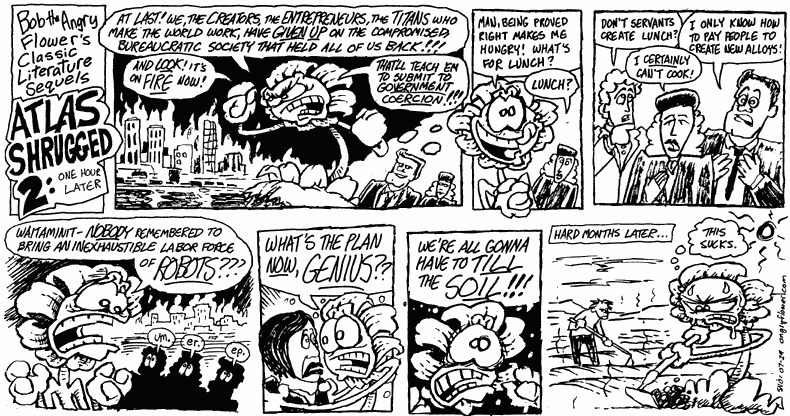
Imagine a world of full, total automation of everything. The rich always needed the less rich to work for them, make things for them, pick up raw materials for them, take care of them, even be their security forces. But all of this would be unneeded with an inexhaustible force of robot labor [1]. This is one of my worries if they ever go all-in with the automation of the military... who will be there to have a crisis of conscience if given immoral orders? We're not there yet, but this is something to ponder.
> It's much easier to just let everyone benefit.
There are things right now that would be easy to do that do not get done. And in any case, I don't think anybody is arguing about what would be easier? Also, before you say it: who cares if it's self-destructive? There's a current subset of rich people who don't care if we're destroying the planet, presumably they don't care that much about their children or their children's children. Or maybe they hand wave it away, "someone, somehow, will take care of this problem in the future".
I just object to your reasoning on so many levels. I regard it as the current zeitgeist of anti-capitalism. Just lazy blame.
We are objectively living in the best times of human history, ever. The global median person in the world is much better off than their predecessors.
Is wealth inequality growing? Yes! This makes people angry. Does that automatically extrapolate to billionaires will murder people (actively or inactively) simply because they can?
A resounding, emphatic, NO. It doesn't extrapolate to that.
What will almost certainly happen is the same as every other time. The technology will disrupt, cause short term pain for some, but ultimately become just another commodity and push up the standard of living for the median person. Billionaires will continue to be billionaires, normal people will adjust, we'll find out ways to put human productivity to use, life will go on.
> What will almost certainly happen is the same as every other time.
This is what seems to me like a failure of imagination. As I said, I envision other possible and even likely futures. I'm not an oracle so I don't guarantee them, I'm just saying we should be aware of those possible futures, and if possible do something about them.
There's no inevitability of progress. That's just wishful thinking.
I respect that you come from a different ideological perspective, but don't disregard mine as lazy. Chalking this up to "lazy anti-capitalism" is, in itself, a lazy position to adopt.
Like you said, it is a failure of imagination. When someone says, "the billionaires and trillionaires won't need anyone else," the dystopian scenerio is not neccesarily "therefore other people won't exist or will eventually become extinct or killed" it's that other people will be straight out enslaved. With all the torture and suffering that entails. You know, the dystopian scenario that is more in line with centuries of recorded human history...The point is the rich won't need to listen to anyone else.
They don't just wake up one day and want to do this. They fear losing their power and want and try to maintain it at considerable cost to others due to that fear. The dynamics of society become such that the power imbalance and wealth inequality continues to increase, until eventually the threshold to something that is indistinguishable from slavery is passed.
Edit: By the way, just the other day the Trump admin trotted out a Doordash grandma in front of the cameras and asked her what she thought of trans women in sports. This grandma is doing doordash to pay off the medical debt of the cancer treatment of her dead husband because the US of A does not provide the minimum healthcare befitting of the richest country on Earth. We are already living in a dystopian fantasy.
We’ve had economies where the majority of rich people existed in a different economy, and everyone else lived in a different economy. Class mobility was poor.
Take the current K shaped economy, where a majority of retail spending is from rich people, and not the majority.
> How do you see AI creating more jobs? (I need some hope right now lol).
More armies of one. That single team of five now becomes 30 teams of one or two each.
Which largely how automation resulted in more jobs - the cost decrease induced demand. Think about how cheap cameras, laptops & internet up-ended traditional media. We went from 3-4 channels on TV in the 60s, to 3-400 channels on cable by the 90s, to 115 million channels on YouTube right now. Because anyone with a basic phone can record and edit content, which used to require millions of dollars in equipment and took years to learn to do. And people are happy to do so for a fraction of the revenue a TV station would require.
A few hundred years ago it took a team of 5 plus draft animals plough a field. Now one guy with a tractor can do it. Some teams and companies will downsize. New companies will appear doing things that we can't even imagine yet.
> New companies will appear doing things that we can't even imagine yet.
I read this take a lot but I don't buy it. This isn't guaranteed by any means. And even if it does happen, isn't it just as likely that AI is deployed into those companies too and they don't actually result in any job growth?
That's not the rebuke you think it is. You made a claim (not original, I've read it before), someone expressed doubts about your claim (which if proven false, will have dire consequences) and you cannot wave it off with "there are no guarantees in life".
Sorry, you made a claim, there's good reason to believe your claim may not pan out, and if it doesn't the consequences are dire.
> New companies will appear doing things that we can't even imagine yet
I have a really big imagination, so I will believe it when I see it. If you have any real idea what these new companies might be doing in the future then I'm all ears. But until then maybe stop trying to claim some kind of future knowledge based on some handwaved nonsense like "we can't even imagine what the future will look like"
And then trying to claim that's "the reality of the situation", please be serious
Edit: Maybe if you think the future is so unimaginable, you should take a look around at the present. Can you identify anything in our lives today that was not imagined by anyone in the past? Think about how every piece of technology ever made nowadays, someone can say "it's like the Torment Nexus from Famous Piece of Literature!"
This comment equates to saying “I don’t care what you think”, and is a perfect example of something that is literally never justified to say on a forum where you have no requirement to interact with them.
If you don’t care what individual people think then simply don’t talk to them.
Yes, if we were computers that could be reprogrammed to new skills.
In the old days change was slow enough that few people got displaced from jobs requiring any substantial skill (although there was local devastation: for example, court reporters.)
Now, however, we are seeing change happening faster than people's careers. You can not realistically retrain into another high skill job--you're going to be the last to be hired. (There's a good reason Social Security Disability has cutoffs a 50 and 60 for how much change can be required!) And, likewise, someone who has worked a desk for decades is not going to be hired for a physical job. (Assuming they even can do it. I can't think of any physical job that wouldn't have me in a lot of pain in weeks at the most.)
> It can't. It can't even deal with emails without randomly deleting your email folder [1].
And early cars were expensive, dangerous, highly unreliable, uncomfortable, belched foul exhaust, and required knowledge of how to drive AND maintain them. We are far, far from that scenario these days.
> Saying that it can make decisions and replace humans is akin of saying that random number generator can make decisions and can replace people.
There are many studies concluding that for some tasks, experts make decisions that are no better than a dice roll, sometimes worse. So the game here is not to make good decisions, but to make a convincing argument. And it is something LLMs are really good at.
And it is ironic because it matches the job of a CEO pretty well. CEOs often make decisions with high uncertainty, the kind where it is hard to beat random, and they are expected to communicate with authority.
> It can't. It can't even deal with emails without randomly deleting your email folder [1]. Saying that it can make decisions and replace humans is akin of saying that random number generator can make decisions and can replace people.
I don't think the comment you're replying to is saying that an evil AI bot will kill people. They are saying something along the lines of: mass job loss doesn't bother the AI companies because in the AI-powered future they envision, population reduction is a positive side effect.
You are proving the point. The avg. person gets an enormous benefit from it, even in countries like USA, Japan or Korea with far less generous welfare. The gap in standards of living of somebody in the US and somebody in Georgia or Vietnam are ridiculous.
Poverty levels are roughly the same between Vietnam and the US from a quick search. Mean standard of living is a poor way to calculate inequality. If you have a link to a median one it would help to compare.
I always found it interesting that homeless folks in the US seem to live in tents a lot of the time, but in my country they rarely have more than a piece of cardboard. I don't know if my perception is incorrect, or if I'm ready too much into this, but my conclusion has been basically what you said: at every socio-economic level, the people at that level have higher standards of living in developed countries than in developing countries.
It’s really hard to compare when you get down to it, even if you ignore “homeless” as a category.
Using money as a proxy doesn’t work perfectly because things can be more expensive, and trying to normalize with things like “living sq ft” doesn’t calculate externalities.
The best I’ve found is to track relative migration pressure - where do people want to go?
Excellent points. In my small island country, prices mostly come down to being labor-dominant or material-dominant. The former is cheaper* than the developed world, whereas the latter is more expensive* than the developed world.
*compared using nominal exchange
>The best I’ve found is to track relative migration pressure - where do people want to go?
I like this approach. It's much more holistic and captures stuff that really cannot be quantified with prices and numbers, like freedoms and rights.
> Poverty is relative. If you have a small apartment in a city of McMansions, you're poor, but if you have a goat in a village of no goats, you're rich.
That worked before globalization. Nowadays, having a small apartment in a city of McMansions means you're upper middle class. Poor people in the west have no apartments and no goats.
Not sure if up to date anymore, but if you look at some samples like here, at equivalent adjusted income levels, people across the world have similar standards of living regardless of where they live.
What is equivalent adjusted income level? PPP between Russia and USA is around 1.8. Median annual salary in the US is $57 ($1196 per week), median salary in Russia is $13200. Even if you adjust it, it's roughly two times smaller.
As someone who lived in a bunch of countries, some rich and some poor, no, living standards among the avg. Joes of the world are not even remotely the same.
Poverty levels are measured relative to median. Poverty in US and poverty in Bangladesh, Russia or Vietnam are completely different things.
In the US poverty line is about $16k, while in Russia for example it is $2300. Even considering the PPP it's like 4 times the difference in living standards. I guess Vietnam or Bangladesh are far worse.
Upd: downvotes with no counterargument. Orange site is becomming more and more a reddit.
> Nearly no one I know in NL and DE works more than 36hrs per week. And we all have a sh”tload of holidays and irregular days off additionally.
In DE I would argue that this is due to punitive taxes and I wouldn't call it progress.
Poor people work their asses 40+ hours and up to overwork since it's always paid here. White collars work less time and often switch to 4 days because at this tax progression working your ass is not worth it. Time is more valuable, indifference curve is screwed.
It also have negative effect on women's careers in combo with 3/5 tax classes thing.
And it hurts EU economies very hard since the most productive ones are disincentivized to work more.
Is this actually a problem? We all know the average white collar worker doesn't actually work for 40 hours despite being at the office. The average - everywhere - is more like the equivalent of 20 hours of solid focused work per week day.
Does more white collar work beyond a threshold produce more value, anyway? Sometimes yes but often no.
I think it’s more that at a certain income, you kind of plateau. You can afford all the little pleasures you want, but you couldn’t meaningfully improve your life without doubling your income. It would not get you a nicer apartment, would not make a house more affordable, and would not give you more time to enjoy travelling.
It seems to me like in Germany, the rock bottom is high but the glass ceiling is low. I am very happy with this, but if you are nearer to the ceiling, it can feel cramped.
I'm not. If you are european and will inherit something it's fine, but if not you'll barely be able to afford a house and a tiny investment portfolio. And at the face of the immense collapse of a pension system it's pretty grim.
This is all about how the housing market is structured, not the amount worked. If people worked even more, house prices would rise further to cancel it.
It’s a mixed blessing. I am Canadian, and I prefer my quiet life and small flat to always being at work or mowing the lawn. I am always stunned to see how much people back home work. My friends in Germany have much more balanced lives.
If it makes you feel better, the pension system is collapsing everywhere. The scarier part is how we will find the workforce to care for us, but I digress.